Hidden In Christmas
Sermon
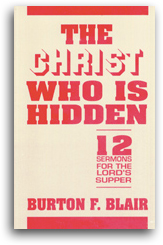
The Christ Who Is Hidden
Sermons For The Lord's Supper
Many years ago, Blackstone, a great English jurist, was called upon to define 'home.' A British nobleman had died. He had inherited titles and castles from both his English and Scottish forebears. The nobleman had spent most of his life abroad. The court was not sure if the nobleman's estate should be judged under Scottish or English law. Where was the nobleman's home?
The great interpreter of law, Blackstone wrote: 'Home is that place from which when a man had departed, he is a wanderer until he had returned.' There are many images that come to mind when the word 'home' is mentioned. It has as many different meanings as there are of us gathered here to worship.
And so very often during this season the question is asked. Those who live away from their families or friends hear it most frequently. 'Are you going home for Christmas?' they are asked.
It is a very simple, yet deeply sentimental question, isn't it? There is no doubt that such a question is meant to suggest that people belong at 'home' for a day like Christmas. But if we will give this question breathing room, it is a far more important question than we have made it out to be. It pushes us to ponder -- 'What will we be doing this Christmas? Will we be going home?'
In the second chapter of Luke, the Christmas story starts: 'In those days there went out a decree that every man should return to the city of his birth…' Everyone was to go home for an enrollment for tax purposes. In other words, every person was to go home for Christmas.
'What about us, are we going home for Christmas this year?' we question.
'Home?' What does that word mean to us this day? Home regardless of its meaning for us, is always so very basic. Yet for most of us it is difficult, if not impossible, for us to define 'home' exactly. We understand very clearly that it is something each of us needs. In fact, it is something desperately needed if our lives are to be safe and secure. Home could be that which was lost by Adam and Eve as they were driven from the Garden of Eden by God's judgment. Home is that sense of belonging that was lost. It becomes our major driving force in our daily lives. It gives us our feeling of not belonging -- or of being lost. We are separated from God, others, and ourselves. We feel that somehow we do not belong.
This kind of feeling for home is the easy simplicity of our youth, the enthusiasm for whatever it was that kept our dreams and hopes alive and well. Or it could be that honest longing to be involved in or by something meaningful and worthwhile. Home is the high ideals we once claimed as our own. But slowly, one by one, we compromised our ideals and eventually, we lost them completely. Perhaps, what I am trying to say is that home was our time of innocence.
Home is when a four-year-old's boyish eyes, on Christmas morning, dart from the view of the tree with its lights and the presents under it and exclaims: 'Oh, boy, Daddy, this is a happy day!' Certainly, this is for most of us what Christmas was. But it is also what Christmas is and can be. In honesty, we know that. Yet what happened?
When did we lose it? For each of us it was once a lovely place, filled with serenity and quietness, a place like the Garden of Eden. We belonged. There our lives were filled with peace. But now look at it. The flowers have all been trampled under foot, or they have simply been over grown with weeds. All our old song birds have flown away. Thus, we no longer hear the music of creation -- the music of our innocence.
Now, we feel lost -- not at one with anything nor anyone. We live in great turmoil and hurt and with our own approaching death. Arguments, disappointments, loneliness, sadness, and hate visit us continuously. Could it be that 'going home for Christmas' is nothing but what we wanted to be for God and never became? Or, home might be that longing that speaks 'with a soft but insistent voice, telling you that your life is empty and meaningless, but that there are chances of a new life waiting before the door of your inner self to fill its void and to conquer its dullness (p. 85, The Eternal Now).'
What about it? Can we go home for Christmas? Are we willing to look deep down inside ourselves -- back to where we have always belonged?
In a way, when we go home for Christmas, there is a point where we must part from one another. You must go your way, and I must go mine. To go home for Christmas, I must go back to some strong memories of a Christmas years ago. I was about 10 years old. Santa Claus was no longer part of the Christmas ritual for me. I knew that my gifts came from my parents' love. I still remember that Christmas morning as if it were just last year. I had asthma on Christmas Eve. I was at my grandmother's house and sitting up on her big feather bed when my father brought me my 'Santa Claus.' I received only two items that morning. I was given a 'scout knife,' and a wooden model of the 'Old Ironside' battleship to build. I can still hear my father say something about financial hard times and wishing that they could have given me more. I do not remember feeling disappointed. I remember feeling loved and being at 'home' for Christmas. I felt that in that place and at that time, I belonged.
We have all been there, haven't we? What happened between then and now? The late Leslie Weatherhead, a British Methodist, writing about a condition among us, penned the words: 'They don't know how to be very happy. They carry their happiness in a small pitcher, but it is the biggest pitcher in their possession, and as long as they don't dream that there is any further happiness to be obtained, they will go on being happy to the limit of their capacity (p. 31, Steady in an Unsteady World).' Most of us have more than we have ever had before, but we are not happy very long. We stay confused. The more we have, the more miserable we are. The more we have, the less we have. We have come to believe that there is no other happiness than what we have already found. And we are not sure if we can ever go home again.
The One who came to that old stable in Bethlehem, that first Christmas, is the One who comes to us this day, calling us home. Christmas is one of those 'wonder events' of God. We know that they happened and, now and then, we experience them too. But we find that we can never fully understand the hows and the whys of the events.
In Christmas, God chose to be part of our lives in an extra special way. God invited himself into the human predicament. God placed himself right in the middle of the pressures that mount, where tempers rise, and where persons hate and disappoint one another. God came to where we are hopelessly confused and lost. It should be said that in Christmas God came home to our world that we might have a chance to be at home in his.
Are we going home for Christmas? In all truthfulness, we can never, in a way, go home for Christmas. For instance, I can never go back to that small Mississippi town again. I am no longer a child. Those who were part of that Christmas morning are all gone, except my mother. I can never hear those chimes that played Christmas chorales from the speakers located on the town's water tank, nor can I see the old Christmas tree that was decorated, down by the train depot. The tree and the depot both have long been gone in this town of my memories. So how can I go home for Christmas?
When Dr. William Hinson was a student-pastor in Georgia, he preached his second sermon in a small church. He recalls that there was a small boy, 10 years old, who heard this second sermon. The little fellow sat on the front row. All the while Hinson was trying to preach, the little fellow waved his bare feet to and fro. Hinson remembered the difficulty he had getting through the sermon due to this activity on the front pew. After the service, the boy invited Hinson to his home for Sunday dinner.
Several weeks later he got a letter in the mail. When he opened it, out came 55 cents in pennies, nickels, and dimes from that little boy. The letter with the money read: 'Dear Brother Bill, I'm sending you my egg money to help you to go to school to learn to be a better preacher.' Dr. Hinson telephoned the boy's father and told him about the money and asked if it was okay to send it back. The father said, 'You can't. He never took better care of those chickens in his life. He's sending you every penny of his profit. He's going to keep on sending you his profit, and if you send it back you'll break his heart.'
Something strange happend to Bill Hinson. All of a sudden, 'Cs' were not good enough, and just getting by was not what he wanted. 'Somebody was laying everything down for me,' he writes, 'and I had no choice but to accept it. I couldn't do anything about it except respond to it (p. 95, Solid Living in a Shattered World).'
As we come to this holy communion this day, we know that we must make some kind of response to the One who invites us. Christmas is simply Christ looking for a heart in which he can make a home. We can go home where we belong in our relationship with God, with others, and with ourselves if we will allow Jesus the Christ to be born in our hearts as we kneel and receive these symbols of belonging. Then and only then, we will be home for Christmas.
The great interpreter of law, Blackstone wrote: 'Home is that place from which when a man had departed, he is a wanderer until he had returned.' There are many images that come to mind when the word 'home' is mentioned. It has as many different meanings as there are of us gathered here to worship.
And so very often during this season the question is asked. Those who live away from their families or friends hear it most frequently. 'Are you going home for Christmas?' they are asked.
It is a very simple, yet deeply sentimental question, isn't it? There is no doubt that such a question is meant to suggest that people belong at 'home' for a day like Christmas. But if we will give this question breathing room, it is a far more important question than we have made it out to be. It pushes us to ponder -- 'What will we be doing this Christmas? Will we be going home?'
In the second chapter of Luke, the Christmas story starts: 'In those days there went out a decree that every man should return to the city of his birth…' Everyone was to go home for an enrollment for tax purposes. In other words, every person was to go home for Christmas.
'What about us, are we going home for Christmas this year?' we question.
'Home?' What does that word mean to us this day? Home regardless of its meaning for us, is always so very basic. Yet for most of us it is difficult, if not impossible, for us to define 'home' exactly. We understand very clearly that it is something each of us needs. In fact, it is something desperately needed if our lives are to be safe and secure. Home could be that which was lost by Adam and Eve as they were driven from the Garden of Eden by God's judgment. Home is that sense of belonging that was lost. It becomes our major driving force in our daily lives. It gives us our feeling of not belonging -- or of being lost. We are separated from God, others, and ourselves. We feel that somehow we do not belong.
This kind of feeling for home is the easy simplicity of our youth, the enthusiasm for whatever it was that kept our dreams and hopes alive and well. Or it could be that honest longing to be involved in or by something meaningful and worthwhile. Home is the high ideals we once claimed as our own. But slowly, one by one, we compromised our ideals and eventually, we lost them completely. Perhaps, what I am trying to say is that home was our time of innocence.
Home is when a four-year-old's boyish eyes, on Christmas morning, dart from the view of the tree with its lights and the presents under it and exclaims: 'Oh, boy, Daddy, this is a happy day!' Certainly, this is for most of us what Christmas was. But it is also what Christmas is and can be. In honesty, we know that. Yet what happened?
When did we lose it? For each of us it was once a lovely place, filled with serenity and quietness, a place like the Garden of Eden. We belonged. There our lives were filled with peace. But now look at it. The flowers have all been trampled under foot, or they have simply been over grown with weeds. All our old song birds have flown away. Thus, we no longer hear the music of creation -- the music of our innocence.
Now, we feel lost -- not at one with anything nor anyone. We live in great turmoil and hurt and with our own approaching death. Arguments, disappointments, loneliness, sadness, and hate visit us continuously. Could it be that 'going home for Christmas' is nothing but what we wanted to be for God and never became? Or, home might be that longing that speaks 'with a soft but insistent voice, telling you that your life is empty and meaningless, but that there are chances of a new life waiting before the door of your inner self to fill its void and to conquer its dullness (p. 85, The Eternal Now).'
What about it? Can we go home for Christmas? Are we willing to look deep down inside ourselves -- back to where we have always belonged?
In a way, when we go home for Christmas, there is a point where we must part from one another. You must go your way, and I must go mine. To go home for Christmas, I must go back to some strong memories of a Christmas years ago. I was about 10 years old. Santa Claus was no longer part of the Christmas ritual for me. I knew that my gifts came from my parents' love. I still remember that Christmas morning as if it were just last year. I had asthma on Christmas Eve. I was at my grandmother's house and sitting up on her big feather bed when my father brought me my 'Santa Claus.' I received only two items that morning. I was given a 'scout knife,' and a wooden model of the 'Old Ironside' battleship to build. I can still hear my father say something about financial hard times and wishing that they could have given me more. I do not remember feeling disappointed. I remember feeling loved and being at 'home' for Christmas. I felt that in that place and at that time, I belonged.
We have all been there, haven't we? What happened between then and now? The late Leslie Weatherhead, a British Methodist, writing about a condition among us, penned the words: 'They don't know how to be very happy. They carry their happiness in a small pitcher, but it is the biggest pitcher in their possession, and as long as they don't dream that there is any further happiness to be obtained, they will go on being happy to the limit of their capacity (p. 31, Steady in an Unsteady World).' Most of us have more than we have ever had before, but we are not happy very long. We stay confused. The more we have, the more miserable we are. The more we have, the less we have. We have come to believe that there is no other happiness than what we have already found. And we are not sure if we can ever go home again.
The One who came to that old stable in Bethlehem, that first Christmas, is the One who comes to us this day, calling us home. Christmas is one of those 'wonder events' of God. We know that they happened and, now and then, we experience them too. But we find that we can never fully understand the hows and the whys of the events.
In Christmas, God chose to be part of our lives in an extra special way. God invited himself into the human predicament. God placed himself right in the middle of the pressures that mount, where tempers rise, and where persons hate and disappoint one another. God came to where we are hopelessly confused and lost. It should be said that in Christmas God came home to our world that we might have a chance to be at home in his.
Are we going home for Christmas? In all truthfulness, we can never, in a way, go home for Christmas. For instance, I can never go back to that small Mississippi town again. I am no longer a child. Those who were part of that Christmas morning are all gone, except my mother. I can never hear those chimes that played Christmas chorales from the speakers located on the town's water tank, nor can I see the old Christmas tree that was decorated, down by the train depot. The tree and the depot both have long been gone in this town of my memories. So how can I go home for Christmas?
When Dr. William Hinson was a student-pastor in Georgia, he preached his second sermon in a small church. He recalls that there was a small boy, 10 years old, who heard this second sermon. The little fellow sat on the front row. All the while Hinson was trying to preach, the little fellow waved his bare feet to and fro. Hinson remembered the difficulty he had getting through the sermon due to this activity on the front pew. After the service, the boy invited Hinson to his home for Sunday dinner.
Several weeks later he got a letter in the mail. When he opened it, out came 55 cents in pennies, nickels, and dimes from that little boy. The letter with the money read: 'Dear Brother Bill, I'm sending you my egg money to help you to go to school to learn to be a better preacher.' Dr. Hinson telephoned the boy's father and told him about the money and asked if it was okay to send it back. The father said, 'You can't. He never took better care of those chickens in his life. He's sending you every penny of his profit. He's going to keep on sending you his profit, and if you send it back you'll break his heart.'
Something strange happend to Bill Hinson. All of a sudden, 'Cs' were not good enough, and just getting by was not what he wanted. 'Somebody was laying everything down for me,' he writes, 'and I had no choice but to accept it. I couldn't do anything about it except respond to it (p. 95, Solid Living in a Shattered World).'
As we come to this holy communion this day, we know that we must make some kind of response to the One who invites us. Christmas is simply Christ looking for a heart in which he can make a home. We can go home where we belong in our relationship with God, with others, and with ourselves if we will allow Jesus the Christ to be born in our hearts as we kneel and receive these symbols of belonging. Then and only then, we will be home for Christmas.