How Unexpected Can Christmas Be?
Sermon
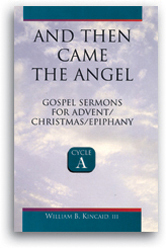
And Then Came the Angel
Gospel Sermons For Advent/Christmas/Epiphany
The temptation is to dismiss these words from Matthew. After all, how do they pertain to us? Written at a time when the early church had bet its life on Jesus' return, these seem odd words to hear on the first Sunday of Advent. We are busy preparing the cr che for a baby, but Matthew appears to be announcing Jesus' second coming. And it isn't just an odd lesson, but a frightening one. In a season when we seek assurance, Matthew's words are enough to scare us half to death. These words compare the coming of God's promised one to the death and devastation of the flood during Noah's time. We are looking forward to being reunited with family and friends while this lesson speaks of untimely separation and unpredictable departure. And then, in the event our Advent and Christmas sensibilities are not offended completely, the coming of Jesus is compared to a thief who breaks into a house at an unexpected hour. Matthew doesn't know much about the holidays.
It is for these reasons that dismissing this passage would be an easy task. Yet, the church includes this lesson or one like it on the first Sunday of Advent of every year. It isn't just Matthew who thinks these are timely and important words. By including this as a lectionary text the church has agreed with the gospel writer. Before we get too far into December, before any significant plans are made about our Advent celebration, the wisdom of the saints dictates that we read this passage from Matthew.
Perhaps it has something to do with this theme of preparation. "Get ready, people," the Lord says, "because I haven't even let the angels in on the secret. I may come at the least expected time. Be prepared!" We appreciate the advice, but we have been getting ready for this season since about this time last year. We bought our wrapping paper the week after Christmas last December. We have picked up gifts throughout the year as we have come across certain unique items that we might not be able to find anywhere else. One strand of Christmas lights was so hard to take down that we decided to leave it up year around. What more preparation could we make?
With an economic landscape that ranges from New York City advertising firms to strip malls anchored by Wal-Mart stores, businesses are making sure we are prepared. It is clear we are still in danger of spending more time at the mall than at the manger, but even these places help us get ready. Before the plastic pumpkins and black capes of Halloween are put away, hints of Christmas are seen in displays here and there. By mid-November shoppers have to step over artificial poinsettias on their way to their favorite department. Called the biggest shopping day of the year, the Friday after Thanksgiving is not for the faint of heart. Christmas trees start standing up in living rooms and sanctuaries alike. Advent wreaths are aglow with promise and light. We attend special services. Greeting cards from loved ones, complete with quotes from scripture, are taped to the mantle with care. We don't want to be too hard on Matthew, especially since the gospel writer did not have two thousand years worth of tradition to draw upon, but we have lots of preparation for Christmas.
Don't you see why it would be so easy to send this lesson into the same scriptural oblivion where we send other Bible passages that we have deemed irrelevant and archaic? Like so many other parts of scripture which seem to fit better with first century Palestine, this is a tough passage for reasonable, intelligent people to take seriously. The frightening words appear to be a poor match for the assurance of Advent. The urgency is lost on a world that does not seem to change much from year to year. As for Matthew's insistence that we be prepared, most of us are more than ready for Christmas to be over with by the time it gets here. You see, the cat is out of the bag. For us, Christmas comes on December 25. That has not always been the date for the celebration of Jesus' birth, but it has been for the last fifteen hundred years. We know Matthew says that not even the angels in heaven know the hour, but it appears that they are the only ones! The rest of us know. It is December 25. It's that date every year, and there is nothing that is even remotely unexpected about it. How could there be?
With this date securely determined, with all the help we have in getting ready, even the late afternoon, Christmas Eve shoppers have no excuse. Yet, in convincing ourselves that we are ready, or at least that we will be ready when time draws closer, there is for some of us this nagging emptiness. Maybe it is the rush of it all. Maybe it is fighting the traffic. Maybe it is the sense of obligation too many gift-givers feel. Maybe it is the financial over-extension which adds pressure to the late-winter months.
For whatever reason, we may find that we are not as prepared as we once thought. Matthew may have been on to something after all. Perhaps it is time to reconsider what it means to be prepared. There is this possibility that being prepared for Christmas means more than finishing our shopping. Advent and Christmas are compromised badly when we focus too much on what is under the tree and too little on who is in the stable. The coming of Christmas is not the same thing as the coming of the Lord.1 It may have been once upon a time, but it's not anymore. "Are you ready for Christmas" asks a different question from "Are you ready for the Lord?" Of course, we are ready for Christmas. With this much notice, everybody ought to be ready for Christmas. "Are you ready for Jesus?" Now, that's a different question.
We have allowed the early Christmas displays to lure us into a false sense of readiness. We have fallen prey to advertisements and commercials that tell us our level of preparation can be measured by whether we have purchased their product for our friend or spouse or child. Even in church, we are led to believe if we light a few candles and bring out the greenery we are somehow ready for Christmas. Well, we may be ready for Christmas, or at least what Christmas has become, but that is not the same thing as being receptive to the presence of God living at the center of our lives.
But hear this: Outlandish ads and outlet malls do not determine the time or the content or the nature of what is at the heart of this celebration. It is not Christmas until God says it is Christmas. The first Christmas happened to coincide with the coming of the Lord. God longs for that to be at the heart of our celebration again. Most of us have tried the commercial side of this holiday and found it to be wanting. We too want our Christmas to coincide with the coming of the Lord. We want that Light to shine into our lives, to illuminate our homes, to dispel the darkness in our world. We want to anchor our lives in that baby named Jesus, to be loved as we have never been loved, to focus our lives on the lasting and important things. We want that Messiah to eradicate evil and eliminate poverty and ease human suffering. We want that voice to stand up for the poor and stand against oppressive powers and stand among the hurting of the world.
Let's be clear about what we are talking about when we refer to "the coming of the Lord." Some are holding out for Jesus to arrive a second time by riding in on a cloud. Some spend so much time speculating about that possibility that they give insufficient consideration to Jesus' first visit. The coming of the Lord in this Advent season has to do with how this story of God-with-us continues to demand our attention and allegiance. The issue is not how God may be revealed at some later point, but how we respond to the way God was revealed at the birth of Jesus. The Word has become flesh and in seasons like this one we focus more intently on what that means for our lives.
The question haunts us. "Are you ready for that kind of Christmas?" To be ready for Christmas in the biblical story does not involve relaxation, but upheaval. We know that the coming of the Lord will challenge priorities and prejudices. We know that the kind of world for which we long cannot be accomplished without confrontation and change. We know that kind of messiah, no doubt, will ask a lot of us. Are we ready for that kind of Christmas?
It is interesting what we have done to this concept of messiah. From time to time we hear people practically making sport of those who were unable to recognize Jesus because he came into the world as a helpless baby. That is, after all, the way a large percentage of us come into the world. There's some question how much anticipation there was for the coming of the messiah. For those who were looking for a messiah, it is usually assumed that they were looking in political palaces and courts of honor and homes of wealth. Our messiah, of course, slipped in the back door through the unlikely entrance of a stable, accompanied by poor parents and smelly animals. It is true that many were so certain of the circumstances of the messiah's birth that they were not able to recognize anything which contradicted their own thinking. That reminds us that we cannot pin down God. This doing-a-new-thing God of ours is full of surprises.
However, in one respect, we are the ones who have missed the point. The hope for a messiah in the Old Testament is a hope for a political figure who would set things right. Part of the reason the people ached for a messiah was because the world was in such a sad shape. A baby, even one named Jesus, was dismissed from consideration because a baby could not bring about the changes that were so desperately needed. And whoever heard of a carpenter from Nazareth becoming the messiah? Then and now, carpenters were useful people, but they did not have the power to correct the injustices.
Hungry people were being ignored. Poor people were being neglected. Sick people were being forgotten. Those who were different were being left out. People of all kinds were yearning for a center to their lives that would bring more hope and meaning than they had been able to find elsewhere.
Today, hungry people are equated with being lazy. City highways are designed to take traffic over and around the out-of-sight, out-of-mind poor. Neighborhoods are closing their hearts and doors to centers where AIDS patients can spend their final days in dignity. And people of all kinds are still yearning for a center to their lives that will bring more hope and meaning than we have been able to find elsewhere.
It will be easier to celebrate Christmas than to celebrate the coming of the Lord. We know that the coming of the Lord into our lives, churches, and communities will mean change. We have made Jesus into an object of personal devotion, but the mission of the messiah was much broader. The messiah was to be a political figure who would establish God's ways as the rule for humankind.2 The messiah did not come to bless our prejudices and to look the other way from our indiscretions. No, the messiah came to lift up the humble and bring down the proud, to call people away from division and into community, to calm fears and instill courage, and to evoke our compassion for the hurting and left-out of the world. And we know changes like that are going to be painful because most of us have something invested in keeping things as they are.
Christmas has a comfortable ring to it, but the coming of the Lord stretches and pulls and gnaws at us. Christmas will allow for family gatherings by the fireplace, but the coming of the Lord will call us to see every person on the planet as part of the family. Christmas will save us from the messiness of a troubled world; the coming of the Lord will save us from ourselves and push us to transform the messiness so that we can have real peace with ourselves and each other.
As it turns out, Matthew was right. We know that a loving God does not want pain and sorrow to continue. We do not know the hour or the day, but we shouldn't be too surprised if some voice calls us to an even greater generosity on behalf of the suffering of the world. We shouldn't be too taken aback if we are tapped on the shoulder and directed toward some worthwhile community project that needs our support. We shouldn't be too startled if we begin noticing things that just aren't right and go to work to change them to benefit other people. We shouldn't be too alarmed if we find ourselves being led to develop a deeper spiritual center for our lives.
It could happen at anytime. Some will respond, some won't. That's okay. At some later point, some other unexpected hour, they too may respond. The good news is that we are sure God isn't going to give up on us. God does not forget or forsake. God comes to us. For some, God brings renewed promises that they are loved. From some, God requires evidence that kind of love is still real and alive in the world. For whatever our part will be, we are asked only to be ready.
____________
1. Fred Craddock, et al., Preaching Through the Christian Year A (Philadelphia: Trinity Press International, 1992), p. 9.
2. Paul J. Achtemeier, General Editor, Harper's Bible Dictionary (San Francisco: Harper, 1985), p. 630.
It is for these reasons that dismissing this passage would be an easy task. Yet, the church includes this lesson or one like it on the first Sunday of Advent of every year. It isn't just Matthew who thinks these are timely and important words. By including this as a lectionary text the church has agreed with the gospel writer. Before we get too far into December, before any significant plans are made about our Advent celebration, the wisdom of the saints dictates that we read this passage from Matthew.
Perhaps it has something to do with this theme of preparation. "Get ready, people," the Lord says, "because I haven't even let the angels in on the secret. I may come at the least expected time. Be prepared!" We appreciate the advice, but we have been getting ready for this season since about this time last year. We bought our wrapping paper the week after Christmas last December. We have picked up gifts throughout the year as we have come across certain unique items that we might not be able to find anywhere else. One strand of Christmas lights was so hard to take down that we decided to leave it up year around. What more preparation could we make?
With an economic landscape that ranges from New York City advertising firms to strip malls anchored by Wal-Mart stores, businesses are making sure we are prepared. It is clear we are still in danger of spending more time at the mall than at the manger, but even these places help us get ready. Before the plastic pumpkins and black capes of Halloween are put away, hints of Christmas are seen in displays here and there. By mid-November shoppers have to step over artificial poinsettias on their way to their favorite department. Called the biggest shopping day of the year, the Friday after Thanksgiving is not for the faint of heart. Christmas trees start standing up in living rooms and sanctuaries alike. Advent wreaths are aglow with promise and light. We attend special services. Greeting cards from loved ones, complete with quotes from scripture, are taped to the mantle with care. We don't want to be too hard on Matthew, especially since the gospel writer did not have two thousand years worth of tradition to draw upon, but we have lots of preparation for Christmas.
Don't you see why it would be so easy to send this lesson into the same scriptural oblivion where we send other Bible passages that we have deemed irrelevant and archaic? Like so many other parts of scripture which seem to fit better with first century Palestine, this is a tough passage for reasonable, intelligent people to take seriously. The frightening words appear to be a poor match for the assurance of Advent. The urgency is lost on a world that does not seem to change much from year to year. As for Matthew's insistence that we be prepared, most of us are more than ready for Christmas to be over with by the time it gets here. You see, the cat is out of the bag. For us, Christmas comes on December 25. That has not always been the date for the celebration of Jesus' birth, but it has been for the last fifteen hundred years. We know Matthew says that not even the angels in heaven know the hour, but it appears that they are the only ones! The rest of us know. It is December 25. It's that date every year, and there is nothing that is even remotely unexpected about it. How could there be?
With this date securely determined, with all the help we have in getting ready, even the late afternoon, Christmas Eve shoppers have no excuse. Yet, in convincing ourselves that we are ready, or at least that we will be ready when time draws closer, there is for some of us this nagging emptiness. Maybe it is the rush of it all. Maybe it is fighting the traffic. Maybe it is the sense of obligation too many gift-givers feel. Maybe it is the financial over-extension which adds pressure to the late-winter months.
For whatever reason, we may find that we are not as prepared as we once thought. Matthew may have been on to something after all. Perhaps it is time to reconsider what it means to be prepared. There is this possibility that being prepared for Christmas means more than finishing our shopping. Advent and Christmas are compromised badly when we focus too much on what is under the tree and too little on who is in the stable. The coming of Christmas is not the same thing as the coming of the Lord.1 It may have been once upon a time, but it's not anymore. "Are you ready for Christmas" asks a different question from "Are you ready for the Lord?" Of course, we are ready for Christmas. With this much notice, everybody ought to be ready for Christmas. "Are you ready for Jesus?" Now, that's a different question.
We have allowed the early Christmas displays to lure us into a false sense of readiness. We have fallen prey to advertisements and commercials that tell us our level of preparation can be measured by whether we have purchased their product for our friend or spouse or child. Even in church, we are led to believe if we light a few candles and bring out the greenery we are somehow ready for Christmas. Well, we may be ready for Christmas, or at least what Christmas has become, but that is not the same thing as being receptive to the presence of God living at the center of our lives.
But hear this: Outlandish ads and outlet malls do not determine the time or the content or the nature of what is at the heart of this celebration. It is not Christmas until God says it is Christmas. The first Christmas happened to coincide with the coming of the Lord. God longs for that to be at the heart of our celebration again. Most of us have tried the commercial side of this holiday and found it to be wanting. We too want our Christmas to coincide with the coming of the Lord. We want that Light to shine into our lives, to illuminate our homes, to dispel the darkness in our world. We want to anchor our lives in that baby named Jesus, to be loved as we have never been loved, to focus our lives on the lasting and important things. We want that Messiah to eradicate evil and eliminate poverty and ease human suffering. We want that voice to stand up for the poor and stand against oppressive powers and stand among the hurting of the world.
Let's be clear about what we are talking about when we refer to "the coming of the Lord." Some are holding out for Jesus to arrive a second time by riding in on a cloud. Some spend so much time speculating about that possibility that they give insufficient consideration to Jesus' first visit. The coming of the Lord in this Advent season has to do with how this story of God-with-us continues to demand our attention and allegiance. The issue is not how God may be revealed at some later point, but how we respond to the way God was revealed at the birth of Jesus. The Word has become flesh and in seasons like this one we focus more intently on what that means for our lives.
The question haunts us. "Are you ready for that kind of Christmas?" To be ready for Christmas in the biblical story does not involve relaxation, but upheaval. We know that the coming of the Lord will challenge priorities and prejudices. We know that the kind of world for which we long cannot be accomplished without confrontation and change. We know that kind of messiah, no doubt, will ask a lot of us. Are we ready for that kind of Christmas?
It is interesting what we have done to this concept of messiah. From time to time we hear people practically making sport of those who were unable to recognize Jesus because he came into the world as a helpless baby. That is, after all, the way a large percentage of us come into the world. There's some question how much anticipation there was for the coming of the messiah. For those who were looking for a messiah, it is usually assumed that they were looking in political palaces and courts of honor and homes of wealth. Our messiah, of course, slipped in the back door through the unlikely entrance of a stable, accompanied by poor parents and smelly animals. It is true that many were so certain of the circumstances of the messiah's birth that they were not able to recognize anything which contradicted their own thinking. That reminds us that we cannot pin down God. This doing-a-new-thing God of ours is full of surprises.
However, in one respect, we are the ones who have missed the point. The hope for a messiah in the Old Testament is a hope for a political figure who would set things right. Part of the reason the people ached for a messiah was because the world was in such a sad shape. A baby, even one named Jesus, was dismissed from consideration because a baby could not bring about the changes that were so desperately needed. And whoever heard of a carpenter from Nazareth becoming the messiah? Then and now, carpenters were useful people, but they did not have the power to correct the injustices.
Hungry people were being ignored. Poor people were being neglected. Sick people were being forgotten. Those who were different were being left out. People of all kinds were yearning for a center to their lives that would bring more hope and meaning than they had been able to find elsewhere.
Today, hungry people are equated with being lazy. City highways are designed to take traffic over and around the out-of-sight, out-of-mind poor. Neighborhoods are closing their hearts and doors to centers where AIDS patients can spend their final days in dignity. And people of all kinds are still yearning for a center to their lives that will bring more hope and meaning than we have been able to find elsewhere.
It will be easier to celebrate Christmas than to celebrate the coming of the Lord. We know that the coming of the Lord into our lives, churches, and communities will mean change. We have made Jesus into an object of personal devotion, but the mission of the messiah was much broader. The messiah was to be a political figure who would establish God's ways as the rule for humankind.2 The messiah did not come to bless our prejudices and to look the other way from our indiscretions. No, the messiah came to lift up the humble and bring down the proud, to call people away from division and into community, to calm fears and instill courage, and to evoke our compassion for the hurting and left-out of the world. And we know changes like that are going to be painful because most of us have something invested in keeping things as they are.
Christmas has a comfortable ring to it, but the coming of the Lord stretches and pulls and gnaws at us. Christmas will allow for family gatherings by the fireplace, but the coming of the Lord will call us to see every person on the planet as part of the family. Christmas will save us from the messiness of a troubled world; the coming of the Lord will save us from ourselves and push us to transform the messiness so that we can have real peace with ourselves and each other.
As it turns out, Matthew was right. We know that a loving God does not want pain and sorrow to continue. We do not know the hour or the day, but we shouldn't be too surprised if some voice calls us to an even greater generosity on behalf of the suffering of the world. We shouldn't be too taken aback if we are tapped on the shoulder and directed toward some worthwhile community project that needs our support. We shouldn't be too startled if we begin noticing things that just aren't right and go to work to change them to benefit other people. We shouldn't be too alarmed if we find ourselves being led to develop a deeper spiritual center for our lives.
It could happen at anytime. Some will respond, some won't. That's okay. At some later point, some other unexpected hour, they too may respond. The good news is that we are sure God isn't going to give up on us. God does not forget or forsake. God comes to us. For some, God brings renewed promises that they are loved. From some, God requires evidence that kind of love is still real and alive in the world. For whatever our part will be, we are asked only to be ready.
____________
1. Fred Craddock, et al., Preaching Through the Christian Year A (Philadelphia: Trinity Press International, 1992), p. 9.
2. Paul J. Achtemeier, General Editor, Harper's Bible Dictionary (San Francisco: Harper, 1985), p. 630.