The Last Beatitude
Sermon
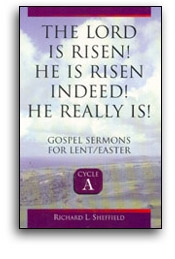
The Lord Is Risen! He Is Risen Indeed! He Really Is!
Gospel Sermons For Lent/Easter
What the disciples of Jesus reported to their fellow disciple Thomas they had seen seemed unbelievable. And Thomas didn't believe it! They said they saw Jesus alive. Well, Thomas saw him alive until late the previous Friday afternoon when Thomas saw him dead. It was now Sunday afternoon -- and to what they said they saw, Thomas' response was, "Seeing is believing," and until I see something different from what I have already seen, I will not believe a word of what you say.
And for that little exchange, Thomas has gone down in history, not as the disciple Thomas, but as "doubting Thomas" -- with his own entry in the dictionary! I looked it up. In the dictionary in the church library, a "doubting Thomas" is defined as "a person who refuses to believe without proof; (a) skeptic."1
And not just about Jesus. About anything. A "doubting Thomas" is one who when presented with an assertion of fact, asserts his or her right to raise questions, and demand proof, and doesn't believe it until they get it.
Thomas wanted tangible, touchable proof of Jesus' resurrection. He had such proof of Jesus' death. He was there. He wanted the same proof of the claim that Jesus, whom he had seen die, had been seen alive by the other disciples. For Thomas there was no doubt that Jesus was dead, and every reason to doubt that Jesus was alive.
Yet, for his honesty, he has gone down in history as "doubting Thomas" -- the man who doubted the resurrection of Jesus Christ. And the term "doubting Thomas" has negative connotations to this day.
But it shouldn't. Because Thomas wasn't and isn't alone, even in this room. And Jesus said not one negative word about him. As Newsweek magazine reported recently: "From the very beginning, the resurrection of Jesus was met by doubt and disbelief. To the Jews of Biblical Jerusalem, it was simply blasphemous for the renegade Christians to claim that a crucified criminal was the Messiah. To the cultivated Greeks, who believed in the soul's immortality, the very idea of a resurrected body was repugnant. Even among Gnostic Christians of the second century, the preferred view was that Jesus was an immortal spirit who merely discarded his mortal cloak. And yet, if the New Testament is to be believed, it was the appearance of the resurrected Christ that lit the flame of Christian faith, and the power of the Holy Spirit that fired a motley band of fearful disciples to proclaim the Risen Jesus throughout the Greco-Roman world. According to the late German Marxist philosopher, Ernst Bloch (says Newsweek), 'It wasn't the morality of the Sermon on the Mount which enabled Christianity to conquer Roman paganism, but the belief that Jesus had been raised from the dead.' "2
There you have it, from Newsweek, just two weeks ago -- never mind 2,000 years ago. The bottomline is what Thomas refused to believe -- couldn't believe -- without proof: that "the Lord is risen"; that "Christ the Lord Is Risen Today"; that "Jesus Christ Is Risen Today." 3 We say it. We sing it. Do we sincerely believe it? Or down deep do we, like Thomas, tend to doubt it?
Don't answer that. It's the wrong question. Nothing in the text says that Thomas doubted anything. Nor does it say we shouldn't. I know that the story I read has Jesus saying: "Do not doubt, but believe" (John 20:27 NRSV). But that isn't the literal translation of Jesus' words to Thomas. It is only one possible interpretation historically conditioned by hindsight about what Thomas had to confront. In the Greek text Jesus says to Thomas, "Do not be unbelieving but believing." Thomas would be better called "Unbelieving Thomas" or "Thomas who couldn't believe the unbelievable just because someone told him to."
Whichever, put that way, Jesus' intent is not just that Thomas stop his "doubting," his questioning, his thinking, the use of "the little grey cells," but that he start believing. The one has to do with debating the facts; the other with putting our trust in something or someone. The one involves my intellect; the other my whole life. The one involves my accepting something as true; the other my discovery that I am accepted by the one who calls himself "the truth" (John 14:6 NRSV).
It is not now and never has been, when it comes to the resurrection of Jesus Christ, a matter of "proving it," so much as "believing in it." And believing in what it means for you and me. That, as we have just sung, "From death to life eternal, From this world to the sky, Our Christ hath brought us over, with hymns of victory." 4
Read the Newsweek article to which I've already alluded, or the similar Time magazine article published the same week. Both were cover stories for Easter. Time's cover read, "The Search for Jesus," and goes on, "Some scholars are debunking the Gospels. Now traditionalists are fighting back. What are Christians to believe?"5
According to the self-appointed "Jesus Seminar" reported on in the article, the answer is "very little." According to them, "Jesus, in fact, 'is an imaginative theological construct, into which have been woven traces of that enigmatic sage from Nazareth -- traces that cry out for recognition and liberation from the firm grip of those whose faith overpowered their memories.' "6
Members of the so-called Jesus Seminar are doing no more than Thomas did, in a sense. Demanding proof. But belief demands more. As Baptist minister Craig Blomberg puts it in the Time article: "You could say ... belief builds on the direction the evidence is already pointing."7 You can prove things to a point, but beyond that point comes belief. Comes trust in the one to whom the evidence is pointing.
That was certainly true for Thomas. With the evidence literally at hand, he did not simply say, "He is risen indeed!" but rather, he said, "My Lord and my God!" (John 20:28 NRSV).
That's more than a simple, "Gee, guys, you're right! He's alive."
That's a statement of belief far beyond simply not doubting what the other disciples had said. "My Lord and my God" is a faith statement of the first order. A belief statement far beyond bickering over biblical facts.
The United Bible Societies' handbook on John's Gospel, written to aid those who translate the Bible into other languages, may be helpful in this regard. It says of Thomas' words, "My Lord and my God": "In certain languages one cannot possess such terms as 'Lord' or 'God.' If so, it may be necessary to translate 'you are the one who rules over me, and you are the one whom I worship.' " 8 That's what Thomas meant.
In the Greek text of our New Testament Thomas calls Jesus "The Lord of me and the God of me."9 My Lord! My God! I believe! That's more than Thomas could have come up with on his own. More than anyone was asking him to believe. And certainly more than the evidence could "prove." Even a dead man walking could only point in that direction.
What Jesus says next is sometimes taken as a putdown of Thomas and those who have a need to "see" -- those whose faith goes seeking things that are provably true: Well, so what, Thomas! What you had to see to believe, others will believe without seeing. Blessed are the others!
But that's the wrong reading. Thomas' blessing was no less because he saw and believed. Raymond Brown translates, "You have believed because you have seen me, (Thomas). Happy are those who have not seen and yet have believed."10
It's not a negative statement: "You had to see to believe, Thomas ...
Better believing is not seeing ..." But a simple statement: "Thomas, you, like the other disciples, have the privilege of seeing and believing ... Others will not see -- but will still believe -- blessed are those also!"
Those -- who? Who is Jesus talking about in this last "beatitude" -- this final "blessed"? Those still to come. Those like you and me. We are those Jesus calls blessed in our struggle to believe. Those who cannot "see," but somehow come to believe, as best we can, in Jesus Christ.
So what do you believe when it comes right down to it? An awful lot of us, I find, believe that God doesn't like us. He puts us down -- as we think Jesus did to Thomas. We know we're supposed to believe that he loves us, but we've never been sure he really likes us. And we're never quite sure what he might do as a result.
Much of Christianity has confused the situation further by making Christian belief into an entrance exam for the hereafter. As though having the right answers, at the right time, will get you into the right place, or out of the wrong one. That in turn has led to dividing ourselves between what I'm supposed to believe and what I really believe. What I'm supposed to believe counts later. I'll get around to that later. What I really believe counts now. I'll get around to that much sooner.
But belief for the writer of John's Gospel, belief for Jesus, was more than that. It is more than that. Belief is more than just ascertaining the facts and figures of faith. Or figuring out the best way to keep God happy long enough to get me into heaven. Belief is living life now certain of the love of God in Jesus Christ for you and me. Living life unafraid -- even of death itself.
That's good news. Something in which to believe in a bad news world, in a world that needs some good news. There is a God who, when we are at our worst, still calls forth our best through our belief in his love. Says the hymn: "Love drowned in death will never die."11 Such love God has shown in the life, death, and resurrection of Jesus Christ.
Trouble is even we, like Thomas, sometimes don't see it and hesitate to believe it. And sometimes it seems to come out that the "good news" about God, is really the "bad news" about us. Repent, we say, and God will forgive you. And some, with television time to fill up and pay for, say it over and over and over, assuring all of us that none of us has ever repented quite enough to please God (or pay their media bills). The problem becomes then: How do we do that if we believe that? How do we ever get to the point of "getting it" -- like Thomas?
Well, of course God forgives those who repent. God forgives and forgets all that stuff you and I can't seem to forgive or forget.
But the Good News is better than that! We may doubt it, but it's true. The Good News is God doesn't need our permission to love us and save us. And he doesn't ask for it before he does it. As the poet puts it:
I sought the Lord,
and afterward I knew
he moved my soul to seek him,
seeking me;
It was not I that found,
O Savior true --
No,
I was found
by thee.12
What Thomas could finally see was something we can still see, something we can believe in. That, as the hymn we'll sing shortly puts it:
Christ is alive, and comes to bring
Good news to this and every age,
'Til earth and sky and ocean ring
With joy, with justice, love, and praise.13
To the living one, our Lord and our God, Jesus Christ.
____________
(For Further Reading: "The Jesus Seminar's misguided quest for the historical Jesus," Christian Century, January 3-10, 1996.)
1. The Random House Dictionary of the English Language.
2. Newsweek, April 8, 1996.
3. Hymn titles found in The Presbyterian Hymnal, no. 113 and no. 112 (Louisville, Kentucky: Westminster/John Knox Press).
4. "The Day Of Resurrection," The Presbyterian Hymnal, no. 118 (Louisville, Kentucky: Westminster/John Knox Press).
5. Time, April 8, 1996, cover.
6. Ibid., p. 54.
7. Ibid., p. 59.
8. Barclay M. Newman and Eugene A. Nida, A Handbook on The Gospel of John, UBS Handbook Series, (New York: United Bible Societies, 1980), p. 619.
9. The Zondervan Parallel New Testament in Greek and English (Grand Rapids, Michigan: Zondervan Bible Publishers, 1980), p. 339.
10. Raymond M. Brown, The Gospel According to John XIII-XXI: A New Translation with Introduction and Commentary (Garden City, New York: Doubleday & Company, Inc., 1978), p. 1019.
11. Brian Wry, "Christ Is Alive!" The Presbyterian Hymnal, no. 108 (Louisville, Kentucky: Westminster/John Knox Press).
12. Source unknown.
13. Brian Wry, "Christ Is Alive!" The Presbyterian Hymnal, no. 108 (Louisville, Kentucky: Westminster/John Knox Press).
And for that little exchange, Thomas has gone down in history, not as the disciple Thomas, but as "doubting Thomas" -- with his own entry in the dictionary! I looked it up. In the dictionary in the church library, a "doubting Thomas" is defined as "a person who refuses to believe without proof; (a) skeptic."1
And not just about Jesus. About anything. A "doubting Thomas" is one who when presented with an assertion of fact, asserts his or her right to raise questions, and demand proof, and doesn't believe it until they get it.
Thomas wanted tangible, touchable proof of Jesus' resurrection. He had such proof of Jesus' death. He was there. He wanted the same proof of the claim that Jesus, whom he had seen die, had been seen alive by the other disciples. For Thomas there was no doubt that Jesus was dead, and every reason to doubt that Jesus was alive.
Yet, for his honesty, he has gone down in history as "doubting Thomas" -- the man who doubted the resurrection of Jesus Christ. And the term "doubting Thomas" has negative connotations to this day.
But it shouldn't. Because Thomas wasn't and isn't alone, even in this room. And Jesus said not one negative word about him. As Newsweek magazine reported recently: "From the very beginning, the resurrection of Jesus was met by doubt and disbelief. To the Jews of Biblical Jerusalem, it was simply blasphemous for the renegade Christians to claim that a crucified criminal was the Messiah. To the cultivated Greeks, who believed in the soul's immortality, the very idea of a resurrected body was repugnant. Even among Gnostic Christians of the second century, the preferred view was that Jesus was an immortal spirit who merely discarded his mortal cloak. And yet, if the New Testament is to be believed, it was the appearance of the resurrected Christ that lit the flame of Christian faith, and the power of the Holy Spirit that fired a motley band of fearful disciples to proclaim the Risen Jesus throughout the Greco-Roman world. According to the late German Marxist philosopher, Ernst Bloch (says Newsweek), 'It wasn't the morality of the Sermon on the Mount which enabled Christianity to conquer Roman paganism, but the belief that Jesus had been raised from the dead.' "2
There you have it, from Newsweek, just two weeks ago -- never mind 2,000 years ago. The bottomline is what Thomas refused to believe -- couldn't believe -- without proof: that "the Lord is risen"; that "Christ the Lord Is Risen Today"; that "Jesus Christ Is Risen Today." 3 We say it. We sing it. Do we sincerely believe it? Or down deep do we, like Thomas, tend to doubt it?
Don't answer that. It's the wrong question. Nothing in the text says that Thomas doubted anything. Nor does it say we shouldn't. I know that the story I read has Jesus saying: "Do not doubt, but believe" (John 20:27 NRSV). But that isn't the literal translation of Jesus' words to Thomas. It is only one possible interpretation historically conditioned by hindsight about what Thomas had to confront. In the Greek text Jesus says to Thomas, "Do not be unbelieving but believing." Thomas would be better called "Unbelieving Thomas" or "Thomas who couldn't believe the unbelievable just because someone told him to."
Whichever, put that way, Jesus' intent is not just that Thomas stop his "doubting," his questioning, his thinking, the use of "the little grey cells," but that he start believing. The one has to do with debating the facts; the other with putting our trust in something or someone. The one involves my intellect; the other my whole life. The one involves my accepting something as true; the other my discovery that I am accepted by the one who calls himself "the truth" (John 14:6 NRSV).
It is not now and never has been, when it comes to the resurrection of Jesus Christ, a matter of "proving it," so much as "believing in it." And believing in what it means for you and me. That, as we have just sung, "From death to life eternal, From this world to the sky, Our Christ hath brought us over, with hymns of victory." 4
Read the Newsweek article to which I've already alluded, or the similar Time magazine article published the same week. Both were cover stories for Easter. Time's cover read, "The Search for Jesus," and goes on, "Some scholars are debunking the Gospels. Now traditionalists are fighting back. What are Christians to believe?"5
According to the self-appointed "Jesus Seminar" reported on in the article, the answer is "very little." According to them, "Jesus, in fact, 'is an imaginative theological construct, into which have been woven traces of that enigmatic sage from Nazareth -- traces that cry out for recognition and liberation from the firm grip of those whose faith overpowered their memories.' "6
Members of the so-called Jesus Seminar are doing no more than Thomas did, in a sense. Demanding proof. But belief demands more. As Baptist minister Craig Blomberg puts it in the Time article: "You could say ... belief builds on the direction the evidence is already pointing."7 You can prove things to a point, but beyond that point comes belief. Comes trust in the one to whom the evidence is pointing.
That was certainly true for Thomas. With the evidence literally at hand, he did not simply say, "He is risen indeed!" but rather, he said, "My Lord and my God!" (John 20:28 NRSV).
That's more than a simple, "Gee, guys, you're right! He's alive."
That's a statement of belief far beyond simply not doubting what the other disciples had said. "My Lord and my God" is a faith statement of the first order. A belief statement far beyond bickering over biblical facts.
The United Bible Societies' handbook on John's Gospel, written to aid those who translate the Bible into other languages, may be helpful in this regard. It says of Thomas' words, "My Lord and my God": "In certain languages one cannot possess such terms as 'Lord' or 'God.' If so, it may be necessary to translate 'you are the one who rules over me, and you are the one whom I worship.' " 8 That's what Thomas meant.
In the Greek text of our New Testament Thomas calls Jesus "The Lord of me and the God of me."9 My Lord! My God! I believe! That's more than Thomas could have come up with on his own. More than anyone was asking him to believe. And certainly more than the evidence could "prove." Even a dead man walking could only point in that direction.
What Jesus says next is sometimes taken as a putdown of Thomas and those who have a need to "see" -- those whose faith goes seeking things that are provably true: Well, so what, Thomas! What you had to see to believe, others will believe without seeing. Blessed are the others!
But that's the wrong reading. Thomas' blessing was no less because he saw and believed. Raymond Brown translates, "You have believed because you have seen me, (Thomas). Happy are those who have not seen and yet have believed."10
It's not a negative statement: "You had to see to believe, Thomas ...
Better believing is not seeing ..." But a simple statement: "Thomas, you, like the other disciples, have the privilege of seeing and believing ... Others will not see -- but will still believe -- blessed are those also!"
Those -- who? Who is Jesus talking about in this last "beatitude" -- this final "blessed"? Those still to come. Those like you and me. We are those Jesus calls blessed in our struggle to believe. Those who cannot "see," but somehow come to believe, as best we can, in Jesus Christ.
So what do you believe when it comes right down to it? An awful lot of us, I find, believe that God doesn't like us. He puts us down -- as we think Jesus did to Thomas. We know we're supposed to believe that he loves us, but we've never been sure he really likes us. And we're never quite sure what he might do as a result.
Much of Christianity has confused the situation further by making Christian belief into an entrance exam for the hereafter. As though having the right answers, at the right time, will get you into the right place, or out of the wrong one. That in turn has led to dividing ourselves between what I'm supposed to believe and what I really believe. What I'm supposed to believe counts later. I'll get around to that later. What I really believe counts now. I'll get around to that much sooner.
But belief for the writer of John's Gospel, belief for Jesus, was more than that. It is more than that. Belief is more than just ascertaining the facts and figures of faith. Or figuring out the best way to keep God happy long enough to get me into heaven. Belief is living life now certain of the love of God in Jesus Christ for you and me. Living life unafraid -- even of death itself.
That's good news. Something in which to believe in a bad news world, in a world that needs some good news. There is a God who, when we are at our worst, still calls forth our best through our belief in his love. Says the hymn: "Love drowned in death will never die."11 Such love God has shown in the life, death, and resurrection of Jesus Christ.
Trouble is even we, like Thomas, sometimes don't see it and hesitate to believe it. And sometimes it seems to come out that the "good news" about God, is really the "bad news" about us. Repent, we say, and God will forgive you. And some, with television time to fill up and pay for, say it over and over and over, assuring all of us that none of us has ever repented quite enough to please God (or pay their media bills). The problem becomes then: How do we do that if we believe that? How do we ever get to the point of "getting it" -- like Thomas?
Well, of course God forgives those who repent. God forgives and forgets all that stuff you and I can't seem to forgive or forget.
But the Good News is better than that! We may doubt it, but it's true. The Good News is God doesn't need our permission to love us and save us. And he doesn't ask for it before he does it. As the poet puts it:
I sought the Lord,
and afterward I knew
he moved my soul to seek him,
seeking me;
It was not I that found,
O Savior true --
No,
I was found
by thee.12
What Thomas could finally see was something we can still see, something we can believe in. That, as the hymn we'll sing shortly puts it:
Christ is alive, and comes to bring
Good news to this and every age,
'Til earth and sky and ocean ring
With joy, with justice, love, and praise.13
To the living one, our Lord and our God, Jesus Christ.
____________
(For Further Reading: "The Jesus Seminar's misguided quest for the historical Jesus," Christian Century, January 3-10, 1996.)
1. The Random House Dictionary of the English Language.
2. Newsweek, April 8, 1996.
3. Hymn titles found in The Presbyterian Hymnal, no. 113 and no. 112 (Louisville, Kentucky: Westminster/John Knox Press).
4. "The Day Of Resurrection," The Presbyterian Hymnal, no. 118 (Louisville, Kentucky: Westminster/John Knox Press).
5. Time, April 8, 1996, cover.
6. Ibid., p. 54.
7. Ibid., p. 59.
8. Barclay M. Newman and Eugene A. Nida, A Handbook on The Gospel of John, UBS Handbook Series, (New York: United Bible Societies, 1980), p. 619.
9. The Zondervan Parallel New Testament in Greek and English (Grand Rapids, Michigan: Zondervan Bible Publishers, 1980), p. 339.
10. Raymond M. Brown, The Gospel According to John XIII-XXI: A New Translation with Introduction and Commentary (Garden City, New York: Doubleday & Company, Inc., 1978), p. 1019.
11. Brian Wry, "Christ Is Alive!" The Presbyterian Hymnal, no. 108 (Louisville, Kentucky: Westminster/John Knox Press).
12. Source unknown.
13. Brian Wry, "Christ Is Alive!" The Presbyterian Hymnal, no. 108 (Louisville, Kentucky: Westminster/John Knox Press).