Life through death
Preaching
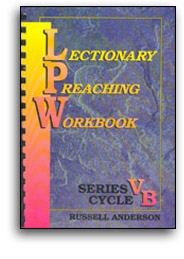
Lectionary Preaching Workbook
Series V, Cycle B
Theme For The Day: Life through death. In the First Lesson Samuel's hopes for God's kingdom die with God's rejection of Saul and are reborn in David. In the Second Lesson Paul is looking forward to death, which would bring him into the presence of the Lord. The Gospel contains the parable of the seeds, which also have to die to be reborn as living fruitful plants.
BRIEF COMMENTARY ON THE LESSONS
Lesson 1: 1 Samuel 15:34-16:13 (C)
God regrets having made Saul king and Samuel mourns Saul's fall from grace. The Lord instructs Samuel to quit mourning for Saul and go anoint his successor. Samuel goes to Bethlehem, ostensibly to conduct a feast before the Lord. The real reason is to anoint Saul's successor. The sons of Jesse are presented to him one by one. None of the seven eldest sons of Jesse are picked. Samuel asks Jesse if he has other sons. He responds that the youngest son is out in the field watching the sheep. David is brought before the prophet and anointed to be king of Israel.
Lesson 1: Ezekiel 17:22--24 (RC)
Lesson 1: Ezekiel 31:1--6, 10--14 (E)
Lesson 2: 2 Corinthians 5:6--10 (11--13) 14--17 (C); 2 Corinthians 5:6--10 (RC); 2 Corinthians 5:1--10 (E)
Paul does not let the weakness of the body and his earthly afflictions discourage him because he looks forward to putting off the cloak of mortality and being with Christ. No matter in what condition he finds himself, he aims to please the Lord. The love of Christ motivates him to proclaim the gospel; that Christ died for all people so that they might no longer live for themselves but for Christ.
Gospel: Mark 4:26--34 (C, RC, E)
This lection brings to conclusion Mark's section on Jesus' parables. The mystery of the kingdom is revealed to the disciples but remains obscure for outsiders. The first parable (vv. 26--29) lifts up the mystery of growth. The seed sprouts and grows of its own, not because of human efforts. The growth of the kingdom is a gift of God. The second parable (vv. 30--32) emphasizes the magnitude of the kingdom's growth and its small beginnings. The mustard seed begins as one of the smallest seeds and grows into one of the largest shrubs, habitat for countless creatures; so it is with the kingdom of God.
Psalm Of The Day
Psalm 20 (C) - "Now I know that the Lord will help his anointed..." (v. 6).
Psalm 92 (E)
Psalm 91 (RC)
Prayer Of The Day
Spirit of God, you have planted the seed of faith in our hearts and rooted us in your kingdom. By your Spirit enable us to grow in faith, love and obedience to your will, that we might reach the fullness of our potential in Christ. In Jesus' name we pray. Amen.
THEOLOGICAL REFLECTIONS ON THE LESSONS
Lesson 1: 1 Samuel 15:34-16:13
The beginning of the end. In the passage prior to this one, Samuel severely dresses down Saul for having disobeyed God in not utterly destroying the Amalekites. Samuel announces that the Lord will replace Saul with a more worthy king. Saul continues to reign for some time yet but his source of authority has been removed. It was the beginning of the end.
Grief work (v. 1). Samuel grieved over Saul. Apparently there were close personal bonds. The Lord tells the prophet to snap out of his grief; it would do no good to mourn that which had happened and could not be changed. There must be a time of grief but that period of mourning must yield to the determination to tackle life anew. God wanted Samuel to focus on the new king, not the old one.
How God judges. When Samuel saw Eliab, Jesse's oldest son, he was impressed with his physical stature and demeanor. God said "No! This isn't the man." Humans judge by outward appearance but God looks at the heart (v. 7).
Lesson 2: 2 Corinthians 5:1--17
Real estate (v. 1). It seems that most people like to possess a little real estate, at least a house and a little piece of ground. Paul compares earthly existence to living in a tent; a tent is quite fragile, temporary and made for traveling. Yet the apostle longs for some real estate, a dwelling not made with human hands, eternal in the heavens (v. 1). That's the only piece of real estate that really matters. There are no mortgage payments for this house, the debt has been removed through the death and resurrection of Christ.
A bearable burden (v. 4). Sometimes we strain and groan under the burdens of life. Two women called into the church office yesterday to share some of their burden; both had lost their jobs. One was told to clean out her desk and leave in 30 minutes. Both of them were groaning under the burden. Yes, life can be a real burden but it's still a bearable burden, as long as we have Christ to bear the burden with us. In Matthew 11, Christ bids all who are burdened to come to him for relief.
Home or away (vv. 6--9). Most people would consider the place where they live and love and work as home. Paul has a different perspective. He says that while we're at home in the body, we're away from the Lord. But when we leave our body we will go home to be with the Lord. Our real home is with the Lord, our real home is heaven.
In Christ, a new creation (v. 17). God doesn't just recycle us in Christ, he makes us completely new. The old selfish attitudes are gone. The old destructive habits and attitudes have been replaced by a fresh outlook.
Gospel: Mark 4:26--34
Growth is in God (vv. 26--29). Growth is a marvelous and mysterious force. While man can sometimes nurture growth, we cannot bring it about. "The earth produces of itself" (v. 28). Growth is of God and so is the growth of the kingdom of God.
The dynamics of growth. The parable says at least three things about growth. First, growth is independent of humans and mysterious; it's a gift of God. Second, growth is orderly; "first the blade, then the head..." Third, growth is fruitful; "full grain on the head." Fourth, there comes the harvest time.
Small beginnings (v. 31). Like the mustard seed which starts small and grows large, the kingdom ushered in by Jesus begins with just twelve men but will ultimately spread over all the earth. Most of us feel quite small at times and our efforts seem insignificant. The parable of the mustard seed gives us hope.
Special education (v. 34). Mark states that Jesus spoke only in parables, except that he explained everything to his disciples privately. You might say that the disciples received special education or tutoring. Being a disciple of Jesus affords us special opportunities to know the full counsel of God. Indeed, the full mystery of the kingdom can only become known by those who are in Christ. The Lord still gives his disciples special education through the Holy Spirit.
SERMON APPROACHES WITH ILLUSTRATIONS
Lesson 1: 1 Samuel 15:34-16:13
Sermon Title: Moving On
Sermon Angle: Samuel was an old man and had seen many changes in his lifetime. Now God had rejected Saul, the one who was to take from him the mantle of leadership. Samuel was depressed as he mourned for Saul, the lame duck king. God came to him and told him to stop living in the past. It was time to move on. God was doing a new thing (v. 1). We learn from this story that it does no good to bewail the past. God told Samuel to fill his horn with oil, symbolic of God's Spirit, and pour it on the one ordained by the Lord. We too must go out with the anointing of God's Spirit.
Outline:
1. Samuel was caught in the past (like a grave).
2. He was told to quit mourning that which was ordained of God.
3. He was ordered out on a new mission, bearing God's Spirit.
Sermon Title: Seeing Through God's Eyes
Sermon Angle: Samuel was impressed with Eliab, the eldest son of Jesse, because he cut such an impressive figure (v. 6). The outward appearance of a person is usually the first thing we notice; it's only human. God sees what's on the inside, God sees the heart. Humans are impressed with statistics, who is the tallest, the fastest, the strongest or the cleverest. God is concerned about spiritual qualities, such as a loving, caring and serving spirit. Through God's Spirit we can learn to see through God's eyes.
Lesson 2: 2 Corinthians 5:1--17
Sermon Title: How To Take Possession Of Your Real Estate
Sermon Angle: When our kids were little we did quite a bit of camping out in a tent. My wife enjoyed the experience for the most part but couldn't get used to sleeping in a tent. She felt vulnerable and exposed. Actually, living in a tent is a metaphor for human existence. Paul tells us that if our tent is destroyed, God has prepared for his saints a new home, eternal in the heavens (v. 1). Through faith we take possession of our real estate.
Sermon Title: A Faith Walk
Sermon Angle: Have you ever participated in a faith walk? That's where two people take turns at leading and following. Typically, the person being led is blindfolded and the other person leads/guides the other person. The object is to develop trust. The apostle reminds us that life is a faith walk. "We walk by faith, not by sight" (v. 7).
Outline:
1. Begin your sermon with a demonstration faith walk. Ask the person how he felt as he was being guided about.
2. Life is a faith walk (v. 7).
3. The more we walk with Jesus, the more we learn to trust him.
4. In heaven faith will yield to sight.
Sermon Title: Your Point Of View
Sermon Angle: Paul points out that being a new creature in Christ causes us to abandon our typical human point of view. He observes that Christians no longer regard Christ from a human point of view (v. 16). Christ is not just a man or a teacher. He is our Savior and our Lord. Nor do we regard other people from a strictly human point of view. They are not objects but people for whom Christ died. We also see ourselves from a new point of view. "If anyone be in Christ, there is a new creation" (v. 17).
Gospel: Mark 4:26--34
Sermon Title: The Joy Of Scattering Seeds
Sermon Angle: Jesus says that the kingdom of God is like a person who scatters seeds (this was the method of sowing in Jesus' day) and then goes about his business in life. All the while, the seeds are growing toward maturity and the man doesn't know how. The farmer doesn't comprehend the dynamics of growth but he doesn't need to. All he has to do is scatter the seed and harvest the grain when it is ripe. I know this seems simplistic. Modern farmers understand much more of the dynamics of growth and are able to intervene in the process to increase the yield. Nevertheless, farmers are still highly dependent on forces outside themselves, which influence the mystery of growth. Nebraska farmers experienced an early freeze in September, 1995, and suffered a twenty to thirty percent reduction in their soybean crop. For the children of God, our greatest joy is to scatter the seeds of the kingdom of God and watch them grow.
Outline:
1. Chances are, if you are here the seed of the kingdom has been planted in your hearts.
2. Others have received the joy of watching us grow.
3. We are called to scatter the kingdom seeds of faith, hope and love.
4. We have the joy of watching God grant them growth.
__________
Oh, God! is one of my favorite movies. God decides to communicate his love to the world through a grocery store manager. He appears to the manager while he is taking a shower. At first the manager tries to avoid being God's spokesman. Finally he holds a news conference to deliver God's message, which precipitates embarrassment and chaos for himself and his family. Toward the end of the movie, the two are evaluating the success of their mission. The manager judges it to be a failure. "Oh, I don't think so," says God. "You never know; a seed here and a seed there, something will catch hold and grow."
Sermon Title: Seasons In The Son
Sermon Angle: The parable of the seeds speaks of three seasons for the crops; I call them seasons in the sun. There is the time of planting (v. 26), the time of growth (vv. 27--28), then the harvest season (v. 29). In the natural world these seasons come successively: planting, growth and then harvest. The church has its Seasons of the Son, Jesus Christ. The functions of planting, growth and harvesting go on simultaneously. The time of planting can be equated with baptism and coming to faith. The period between baptism and death corresponds to the season of growth. The harvest season comes when the seeds of the gospel bear fruit and people are brought to faith or renewal of faith. Of course, death can be viewed as the ultimate harvest time when the seasons of the Son are brought to full fruit.
Outline:
1. The natural world has its seasons in the sun.
2. The church has its seasons of the Son.
- Planting.
- Growth.
- Harvest.
Sermon Title: Small Beginnings
Sermon Angle: The parable of the mustard seed lifts up for us the miracle of growth. A mustard seed is ever so small and yet becomes a great shrub. Almost everything begins small. The human being begins when two microscopic cells come together and grow explosively both in size and complexity. The kingdom is part of this growth explosion, starting with a few people who transform into a multitude.
Outline:
1. The point of the parable is that small can become great.
2. We shouldn't worry about size but only about growing according to God's pattern.
3. The kingdom of God and the good we do in Christ's name will grow great.
__________
The parable of the mustard seed makes much the same point, though the emphasis here is the smallness of the seed. God's kingdom starts out as a tiny, insignificant seed that grows astronomically. The power is in the seed. Speaking of small seeds growing large, an article about financier Warren Buffett, in U.S. News, states that if you would have been farsighted enough to have invested $10,000 in 1956 with Buffett's company, it would be worth an unbelievable $60,000,000 today. This, of course, has nothing to do God's kingdom except to demonstrate how some seeds have enormous potential for growth. If we scatter God's seed he promises that some will produce mightily.
BRIEF COMMENTARY ON THE LESSONS
Lesson 1: 1 Samuel 15:34-16:13 (C)
God regrets having made Saul king and Samuel mourns Saul's fall from grace. The Lord instructs Samuel to quit mourning for Saul and go anoint his successor. Samuel goes to Bethlehem, ostensibly to conduct a feast before the Lord. The real reason is to anoint Saul's successor. The sons of Jesse are presented to him one by one. None of the seven eldest sons of Jesse are picked. Samuel asks Jesse if he has other sons. He responds that the youngest son is out in the field watching the sheep. David is brought before the prophet and anointed to be king of Israel.
Lesson 1: Ezekiel 17:22--24 (RC)
Lesson 1: Ezekiel 31:1--6, 10--14 (E)
Lesson 2: 2 Corinthians 5:6--10 (11--13) 14--17 (C); 2 Corinthians 5:6--10 (RC); 2 Corinthians 5:1--10 (E)
Paul does not let the weakness of the body and his earthly afflictions discourage him because he looks forward to putting off the cloak of mortality and being with Christ. No matter in what condition he finds himself, he aims to please the Lord. The love of Christ motivates him to proclaim the gospel; that Christ died for all people so that they might no longer live for themselves but for Christ.
Gospel: Mark 4:26--34 (C, RC, E)
This lection brings to conclusion Mark's section on Jesus' parables. The mystery of the kingdom is revealed to the disciples but remains obscure for outsiders. The first parable (vv. 26--29) lifts up the mystery of growth. The seed sprouts and grows of its own, not because of human efforts. The growth of the kingdom is a gift of God. The second parable (vv. 30--32) emphasizes the magnitude of the kingdom's growth and its small beginnings. The mustard seed begins as one of the smallest seeds and grows into one of the largest shrubs, habitat for countless creatures; so it is with the kingdom of God.
Psalm Of The Day
Psalm 20 (C) - "Now I know that the Lord will help his anointed..." (v. 6).
Psalm 92 (E)
Psalm 91 (RC)
Prayer Of The Day
Spirit of God, you have planted the seed of faith in our hearts and rooted us in your kingdom. By your Spirit enable us to grow in faith, love and obedience to your will, that we might reach the fullness of our potential in Christ. In Jesus' name we pray. Amen.
THEOLOGICAL REFLECTIONS ON THE LESSONS
Lesson 1: 1 Samuel 15:34-16:13
The beginning of the end. In the passage prior to this one, Samuel severely dresses down Saul for having disobeyed God in not utterly destroying the Amalekites. Samuel announces that the Lord will replace Saul with a more worthy king. Saul continues to reign for some time yet but his source of authority has been removed. It was the beginning of the end.
Grief work (v. 1). Samuel grieved over Saul. Apparently there were close personal bonds. The Lord tells the prophet to snap out of his grief; it would do no good to mourn that which had happened and could not be changed. There must be a time of grief but that period of mourning must yield to the determination to tackle life anew. God wanted Samuel to focus on the new king, not the old one.
How God judges. When Samuel saw Eliab, Jesse's oldest son, he was impressed with his physical stature and demeanor. God said "No! This isn't the man." Humans judge by outward appearance but God looks at the heart (v. 7).
Lesson 2: 2 Corinthians 5:1--17
Real estate (v. 1). It seems that most people like to possess a little real estate, at least a house and a little piece of ground. Paul compares earthly existence to living in a tent; a tent is quite fragile, temporary and made for traveling. Yet the apostle longs for some real estate, a dwelling not made with human hands, eternal in the heavens (v. 1). That's the only piece of real estate that really matters. There are no mortgage payments for this house, the debt has been removed through the death and resurrection of Christ.
A bearable burden (v. 4). Sometimes we strain and groan under the burdens of life. Two women called into the church office yesterday to share some of their burden; both had lost their jobs. One was told to clean out her desk and leave in 30 minutes. Both of them were groaning under the burden. Yes, life can be a real burden but it's still a bearable burden, as long as we have Christ to bear the burden with us. In Matthew 11, Christ bids all who are burdened to come to him for relief.
Home or away (vv. 6--9). Most people would consider the place where they live and love and work as home. Paul has a different perspective. He says that while we're at home in the body, we're away from the Lord. But when we leave our body we will go home to be with the Lord. Our real home is with the Lord, our real home is heaven.
In Christ, a new creation (v. 17). God doesn't just recycle us in Christ, he makes us completely new. The old selfish attitudes are gone. The old destructive habits and attitudes have been replaced by a fresh outlook.
Gospel: Mark 4:26--34
Growth is in God (vv. 26--29). Growth is a marvelous and mysterious force. While man can sometimes nurture growth, we cannot bring it about. "The earth produces of itself" (v. 28). Growth is of God and so is the growth of the kingdom of God.
The dynamics of growth. The parable says at least three things about growth. First, growth is independent of humans and mysterious; it's a gift of God. Second, growth is orderly; "first the blade, then the head..." Third, growth is fruitful; "full grain on the head." Fourth, there comes the harvest time.
Small beginnings (v. 31). Like the mustard seed which starts small and grows large, the kingdom ushered in by Jesus begins with just twelve men but will ultimately spread over all the earth. Most of us feel quite small at times and our efforts seem insignificant. The parable of the mustard seed gives us hope.
Special education (v. 34). Mark states that Jesus spoke only in parables, except that he explained everything to his disciples privately. You might say that the disciples received special education or tutoring. Being a disciple of Jesus affords us special opportunities to know the full counsel of God. Indeed, the full mystery of the kingdom can only become known by those who are in Christ. The Lord still gives his disciples special education through the Holy Spirit.
SERMON APPROACHES WITH ILLUSTRATIONS
Lesson 1: 1 Samuel 15:34-16:13
Sermon Title: Moving On
Sermon Angle: Samuel was an old man and had seen many changes in his lifetime. Now God had rejected Saul, the one who was to take from him the mantle of leadership. Samuel was depressed as he mourned for Saul, the lame duck king. God came to him and told him to stop living in the past. It was time to move on. God was doing a new thing (v. 1). We learn from this story that it does no good to bewail the past. God told Samuel to fill his horn with oil, symbolic of God's Spirit, and pour it on the one ordained by the Lord. We too must go out with the anointing of God's Spirit.
Outline:
1. Samuel was caught in the past (like a grave).
2. He was told to quit mourning that which was ordained of God.
3. He was ordered out on a new mission, bearing God's Spirit.
Sermon Title: Seeing Through God's Eyes
Sermon Angle: Samuel was impressed with Eliab, the eldest son of Jesse, because he cut such an impressive figure (v. 6). The outward appearance of a person is usually the first thing we notice; it's only human. God sees what's on the inside, God sees the heart. Humans are impressed with statistics, who is the tallest, the fastest, the strongest or the cleverest. God is concerned about spiritual qualities, such as a loving, caring and serving spirit. Through God's Spirit we can learn to see through God's eyes.
Lesson 2: 2 Corinthians 5:1--17
Sermon Title: How To Take Possession Of Your Real Estate
Sermon Angle: When our kids were little we did quite a bit of camping out in a tent. My wife enjoyed the experience for the most part but couldn't get used to sleeping in a tent. She felt vulnerable and exposed. Actually, living in a tent is a metaphor for human existence. Paul tells us that if our tent is destroyed, God has prepared for his saints a new home, eternal in the heavens (v. 1). Through faith we take possession of our real estate.
Sermon Title: A Faith Walk
Sermon Angle: Have you ever participated in a faith walk? That's where two people take turns at leading and following. Typically, the person being led is blindfolded and the other person leads/guides the other person. The object is to develop trust. The apostle reminds us that life is a faith walk. "We walk by faith, not by sight" (v. 7).
Outline:
1. Begin your sermon with a demonstration faith walk. Ask the person how he felt as he was being guided about.
2. Life is a faith walk (v. 7).
3. The more we walk with Jesus, the more we learn to trust him.
4. In heaven faith will yield to sight.
Sermon Title: Your Point Of View
Sermon Angle: Paul points out that being a new creature in Christ causes us to abandon our typical human point of view. He observes that Christians no longer regard Christ from a human point of view (v. 16). Christ is not just a man or a teacher. He is our Savior and our Lord. Nor do we regard other people from a strictly human point of view. They are not objects but people for whom Christ died. We also see ourselves from a new point of view. "If anyone be in Christ, there is a new creation" (v. 17).
Gospel: Mark 4:26--34
Sermon Title: The Joy Of Scattering Seeds
Sermon Angle: Jesus says that the kingdom of God is like a person who scatters seeds (this was the method of sowing in Jesus' day) and then goes about his business in life. All the while, the seeds are growing toward maturity and the man doesn't know how. The farmer doesn't comprehend the dynamics of growth but he doesn't need to. All he has to do is scatter the seed and harvest the grain when it is ripe. I know this seems simplistic. Modern farmers understand much more of the dynamics of growth and are able to intervene in the process to increase the yield. Nevertheless, farmers are still highly dependent on forces outside themselves, which influence the mystery of growth. Nebraska farmers experienced an early freeze in September, 1995, and suffered a twenty to thirty percent reduction in their soybean crop. For the children of God, our greatest joy is to scatter the seeds of the kingdom of God and watch them grow.
Outline:
1. Chances are, if you are here the seed of the kingdom has been planted in your hearts.
2. Others have received the joy of watching us grow.
3. We are called to scatter the kingdom seeds of faith, hope and love.
4. We have the joy of watching God grant them growth.
__________
Oh, God! is one of my favorite movies. God decides to communicate his love to the world through a grocery store manager. He appears to the manager while he is taking a shower. At first the manager tries to avoid being God's spokesman. Finally he holds a news conference to deliver God's message, which precipitates embarrassment and chaos for himself and his family. Toward the end of the movie, the two are evaluating the success of their mission. The manager judges it to be a failure. "Oh, I don't think so," says God. "You never know; a seed here and a seed there, something will catch hold and grow."
Sermon Title: Seasons In The Son
Sermon Angle: The parable of the seeds speaks of three seasons for the crops; I call them seasons in the sun. There is the time of planting (v. 26), the time of growth (vv. 27--28), then the harvest season (v. 29). In the natural world these seasons come successively: planting, growth and then harvest. The church has its Seasons of the Son, Jesus Christ. The functions of planting, growth and harvesting go on simultaneously. The time of planting can be equated with baptism and coming to faith. The period between baptism and death corresponds to the season of growth. The harvest season comes when the seeds of the gospel bear fruit and people are brought to faith or renewal of faith. Of course, death can be viewed as the ultimate harvest time when the seasons of the Son are brought to full fruit.
Outline:
1. The natural world has its seasons in the sun.
2. The church has its seasons of the Son.
- Planting.
- Growth.
- Harvest.
Sermon Title: Small Beginnings
Sermon Angle: The parable of the mustard seed lifts up for us the miracle of growth. A mustard seed is ever so small and yet becomes a great shrub. Almost everything begins small. The human being begins when two microscopic cells come together and grow explosively both in size and complexity. The kingdom is part of this growth explosion, starting with a few people who transform into a multitude.
Outline:
1. The point of the parable is that small can become great.
2. We shouldn't worry about size but only about growing according to God's pattern.
3. The kingdom of God and the good we do in Christ's name will grow great.
__________
The parable of the mustard seed makes much the same point, though the emphasis here is the smallness of the seed. God's kingdom starts out as a tiny, insignificant seed that grows astronomically. The power is in the seed. Speaking of small seeds growing large, an article about financier Warren Buffett, in U.S. News, states that if you would have been farsighted enough to have invested $10,000 in 1956 with Buffett's company, it would be worth an unbelievable $60,000,000 today. This, of course, has nothing to do God's kingdom except to demonstrate how some seeds have enormous potential for growth. If we scatter God's seed he promises that some will produce mightily.