Love Is A Many Splendored Thing
Sermon
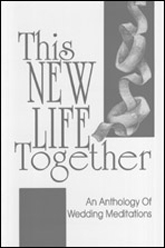
THIS NEW LIFE TOGETHER
An Anthology Of Wedding Meditations
Some of us here today will remember The Four Aces, a popular singing group from the mid 1950s, and their hit recording of ''Love Is A Many Splendored Thing.'' Indeed, love is a many splendored thing - a truth celebrated and attested to us by the special fascination of weddings, with their wonderful music, bright smiles and all those new or rented clothes.
But that is only the half of it. Love also is a many splintered thing. It is one of the two most basic human emotions, the other of which is hate, according to some understandings of psychology. Both emotions are always present in every human relationship.
If these elements are so important to human personality and to the ways we relate to one another, then surely one of life's major challenges is to learn to deal creatively with the sense of ambivalence they represent. Life's contrary emotions remind us that at every point of decision, at every moment of commitment, we are choosing among alternatives. Saying ''yes'' to this one means saying ''no'' to a whole array of others. Today we are here to witness the ''yes'' being said to each other by __________ and __________.
The writer of the Song of Solomon, one of the most beautiful and erotic love poems ever written, says of love: ''Its flashes are flashes of fire.'' Which is another way of saying that love is both a many splendored thing and a many splintered one as well. It is life's most enduring and rewarding emotion. It is also its most dangerous.
The Greek language in which the New Testament is primarily written knows three words which are rendered as ''love'' in English, and each word has a specific and special meaning. One of these words, the one used most often by New Testament writers is agape. This is a selfless love, unmotivated by such factors as beauty or worth. It describes God's love for us, because God loves us not because of what we might do for God, not because of our beauty or goodness, but only because God is love. We cannot return such love in kind; we respond to it only with faith - acceptance, commitment - giving ourselves over to the God who loves us so. We celebrate that in this service today, too.
Another of the words for love, and one which the New Testament never uses, is eros, from which comes our word ''erotic.'' This is sexual love, a vital healthy part of what it means to be human. As people of faith who are also sexual beings, we celebrate that today, as well.
The third word, philao, means filial love, the love of husband and wife, of parents and children, of deep and abiding friends. It partakes of portions of each of the other concepts, and does honor to the genuine humanity of those who share it and to the spiritual and physical bond that unites them.
It is this love - their love for each other and the love God has for them - that we celebrate with __________ and __________ today in this public recognition of their special personal and spiritual relationship, and which is the key to a Christian understanding of love and marriage. It provides for the creative expression and fulfillment of our human personalities and potential. It has room for give--and--take; it allows for the existence, the acceptance, and sometimes even the settling, of differences by way of affectionate understanding and reasonableness.
Which is not to say that in love all differences between a wife and husband will be settled. There are some differences in every human relationship which simply must be accepted and lived with. Marriage is far too complex a relationship to expect unanimity. G. K. Chesterton once observed that he
had seen many happy marriages, but never a compatible one. Even so, Christian marriage brings to this relationship, to this ''yes'' said between two distinct individuals, that element of spiritual commitment which we intend ''till death do us part.'' It is this intentional spiritual bond that lends a sense of permanence, and therefore its own special form of freedom and trust, to the marriage relationships.
So, in this context, hear again the words of Paul, this time as they are expressed in paraphrase by J. B. Phillips:
''This love of which I speak is slow to lose patience - it looks for a way of being constructive. It is not possessive: it is neither anxious to impress nor does it cherish inflated ideas of its own importance.
''Love has good manners and does not pursue selfish advantage. It is not touchy. It does not keep account of evil or gloat over the wickedness of other people. On the contrary, it is glad with all ... when truth prevails.
''Love knows no limit to its endurance, no end to its trust, no fading of its hope; it can outlast anything. It is, in fact, the one thing that still stands when all else has fallen.''
John C. Bush is pastor of Grace Presbyterian Church, Madison, Alabama.
But that is only the half of it. Love also is a many splintered thing. It is one of the two most basic human emotions, the other of which is hate, according to some understandings of psychology. Both emotions are always present in every human relationship.
If these elements are so important to human personality and to the ways we relate to one another, then surely one of life's major challenges is to learn to deal creatively with the sense of ambivalence they represent. Life's contrary emotions remind us that at every point of decision, at every moment of commitment, we are choosing among alternatives. Saying ''yes'' to this one means saying ''no'' to a whole array of others. Today we are here to witness the ''yes'' being said to each other by __________ and __________.
The writer of the Song of Solomon, one of the most beautiful and erotic love poems ever written, says of love: ''Its flashes are flashes of fire.'' Which is another way of saying that love is both a many splendored thing and a many splintered one as well. It is life's most enduring and rewarding emotion. It is also its most dangerous.
The Greek language in which the New Testament is primarily written knows three words which are rendered as ''love'' in English, and each word has a specific and special meaning. One of these words, the one used most often by New Testament writers is agape. This is a selfless love, unmotivated by such factors as beauty or worth. It describes God's love for us, because God loves us not because of what we might do for God, not because of our beauty or goodness, but only because God is love. We cannot return such love in kind; we respond to it only with faith - acceptance, commitment - giving ourselves over to the God who loves us so. We celebrate that in this service today, too.
Another of the words for love, and one which the New Testament never uses, is eros, from which comes our word ''erotic.'' This is sexual love, a vital healthy part of what it means to be human. As people of faith who are also sexual beings, we celebrate that today, as well.
The third word, philao, means filial love, the love of husband and wife, of parents and children, of deep and abiding friends. It partakes of portions of each of the other concepts, and does honor to the genuine humanity of those who share it and to the spiritual and physical bond that unites them.
It is this love - their love for each other and the love God has for them - that we celebrate with __________ and __________ today in this public recognition of their special personal and spiritual relationship, and which is the key to a Christian understanding of love and marriage. It provides for the creative expression and fulfillment of our human personalities and potential. It has room for give--and--take; it allows for the existence, the acceptance, and sometimes even the settling, of differences by way of affectionate understanding and reasonableness.
Which is not to say that in love all differences between a wife and husband will be settled. There are some differences in every human relationship which simply must be accepted and lived with. Marriage is far too complex a relationship to expect unanimity. G. K. Chesterton once observed that he
had seen many happy marriages, but never a compatible one. Even so, Christian marriage brings to this relationship, to this ''yes'' said between two distinct individuals, that element of spiritual commitment which we intend ''till death do us part.'' It is this intentional spiritual bond that lends a sense of permanence, and therefore its own special form of freedom and trust, to the marriage relationships.
So, in this context, hear again the words of Paul, this time as they are expressed in paraphrase by J. B. Phillips:
''This love of which I speak is slow to lose patience - it looks for a way of being constructive. It is not possessive: it is neither anxious to impress nor does it cherish inflated ideas of its own importance.
''Love has good manners and does not pursue selfish advantage. It is not touchy. It does not keep account of evil or gloat over the wickedness of other people. On the contrary, it is glad with all ... when truth prevails.
''Love knows no limit to its endurance, no end to its trust, no fading of its hope; it can outlast anything. It is, in fact, the one thing that still stands when all else has fallen.''
John C. Bush is pastor of Grace Presbyterian Church, Madison, Alabama.