Our Work, Our Mission Field
Preaching
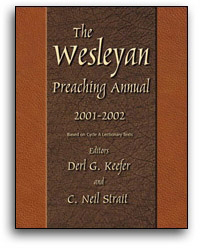
THE WESLEYAN PREACHING ANNUAL 2001--2002
Tony Campolo tells the story of an English professor who suddenly quit his job. The dean, and the professor's own mother, tried to talk him out of quitting. But his decision stayed. The mother pleaded with Campolo to visit him and try to change his mind.
The professor explained to Campolo his reasons for quitting. The apathy of students had gotten to him. He said, "Every time I walked into that classroom, I died a little bit." After a considerable dialogue with the professor, Campolo could not dissuade the professor. Campolo asked, "What are you going to do now to make a living?" The professor's reply was, "I'm a mailman."
Campolo and the professor talked about his new job for awhile, then Campolo said, "Well, if you're going to be a mailman, be the best mailman you can possibly be!" The professor's reply shocked Campolo, at first. "I'm a lousy mailman," he answered. "Everybody else in my post office gets the mail delivered by two--thirty in the afternoon, or three at the latest. I never get it delivered until about five."
"What takes you so long?" Campolo inquired. "I visit," he said. "You can't image how many people on my route never got visited until I became the mailman. There are interesting people on my route who are interested in literature. There are hurting people who need the comfort that comes from the great poets."
Campolo said he was not surprised when after a year of mail delivery, the people on his route had thrown a birthday party for their mail carrier. Campolo observes: "He was special to them, and they were special to him. His mail route had become a mission field (Tony Campolo, Let Me Tell You a Story, Nashville: Word Publishing, 2000, pp. 170--171).
Every pastor is like that mail carrier. Under his/her care are people who need comfort and care, people who need to share their story and who need a listening ear. The pastor who can care and comfort, listen and sympathize, will become a special person to his/her people.
Our Wesleyan heritage teaches us that loving and caring are New Testament patterns for Christian living. If it is a pattern for Christians, how much more so for pastors. Kennon Callahan, in his book, A New Beginning for Pastors and Congregations, states: "... the foundation of leading is love. People long for and look for a pastor who puts people first, who cares more about helping them with their lives than about the survival of an institution or the growth of an organization" (San Francisco: Jossey--Bass, 1999, p. 36).
People are our calling, our mission field. How we respond to them, love them, care for them, will determine how our ideas are accepted and our ministries succeed. Dale Galloway, in an unpublished manuscript, says: "Everyone at church wants to know, 'Does the pastor care about me?' They may love your ideas, but if they don't think you love them, they won't hear you. Showing your love is as simple as spending time to build one--on--one relationship with them" ("On Purpose Leadership," unpublished, p. 52).
Shepherding was relegated to last status in the decade of the '80s and '90s when too many listened to the Church Growth "specialists" who were promoting CEO pastors and going overboard on leadership. Neither was biblical nor too successful. More and more we are coming to realize that, in a highly technical age, people still need love, care, comfort, and relationship. Shepherding is back.
May you and I, in our day--to--day ministries, keep the main thing, the main thing - love people, listen to them, comfort them and build deep relationships with them.
C. Neil Strait
August 4, 2002 Eleventh Sunday After Pentecost
WORSHIP HELPS
CALL TO WORSHIP (Unison)
"The Lord is my shepherd, I shall not be in want. He makes me lie down in green pastures, he leads me beside quiet waters, he restores my soul. He guides me in paths of righteousness for his name's sake. Even though I walk through the valley of the shadow of death, I will fear no evil, for you are with me; your rod and your staff, they comfort me. You prepare a table before me in the presence of my enemies. You anoint my head with oil; my cup overflows. Surely goodness and love will follow me all the days of my life, and I will dwell in the house of the Lord forever." (Psalm 23 NIV)
OFFERING THOUGHT
Giving to others is important, God. Helping, sharing, and compassion are requirements of love. May we also remember that spending time with you, God, precedes giving to others. Amen.
BENEDICTION
Now to the God who promises His people will be all glory and honor and praise throughout this day!
SERMON BRIEFS
Confession
Genesis 32:22--31
Introduction
The story of Jacob's encounter with God on this night cannot be fully understood without a review of his story leading up to this night.
Born a twin, Jacob soon developed a personality very different from his brother Esau. Esau was the hunter, living in the open while Jacob was a quiet man, staying among the tents. Jacob first really lived up to his name - "he deceives" - when he bought the birthright from Esau for some stew (Genesis 25:29--34).
Jacob brought off the ultimate swindle when he stole the blessing from Isaac which should have gone to Esau (Genesis 27:1--35).
In both cases, Jacob was attempting to get in his own strength and in his own time what God would have given him. If we attempt to force God to act, we only compound our suffering. If we take what God does not give, it changes in our hands. That was the experience of Gehaze as recorded in 2 Kings 5:19--27.
Because of what Jacob had done, Esau planned to kill him. Jacob fled to save his life and ended up with Laban, his uncle. While there Jacob married Leah and Rachel, had children and became wealthy. The time came that Jacob and Laban decided to part ways and we pick up the story of Jacob as he is returning to meet his brother once again.
Read Genesis 32:22--31.
Jacob sought to pave the way for his meeting with gifts. The meeting turned out not to be the great conflict he had feared, rather it was a joyous reunion. The difference was made not by the gifts, but by the night in which Jacob wrestled with God. Let us learn from this night Jacob spent.
I. When we face conflicts, we must be honest about their source.
A. There may be conflicts in our lives, even among members of the family of God. What Jacob experienced with his brother is not unique among brothers in history. These conflicts call for confession in order to be cleared.
B. Conflicts often arise from our failure to be honest and trusting toward one another. Paul's admonition is valid in these areas of conflict. "Therefore each of you must put off falsehood and speak truthfully to his neighbor, for we are all members of one body" (Ephesians 4:25 NIV).
C. Conflicts may also have their roots in our attempts to do God's work in our strength and in our time. We, like Jacob, may try to wrest from the hand of God what He would give us in His time. Whenever we do, we create conflict unnecessarily.
II. We learn here that riches will not help us resolve our conflicts.
Jacob tried to pave the way for his reunion by sending gifts ahead.
A. Jacob discovered that what he needed was a change of heart which could come only from the touch of God in his life. We may be tempted to depend on our external resources when we really need to be changed by God.
B. The touch of God in Jacob's life could come only after confession. We too must confess to God who we are - our "name" - and our need of him. Confession opens the door to change that only God can bring.
III. When Jacob did meet Esau, the reunion was positive.
God opens the door of fellowship to us just as He did to Jacob.
A. Our fellowship with God or with others is not based on the "gifts" we may bring to the relationship.
B. Rather, our fellowship is based upon our common experience. We have come to Christ and found forgiveness. Jacob has wrestled with God and was touched by Him. As we confess our need, God meets our need and we are ushered into fellowship with Him.
Conclusion
As Jacob left this encounter with God, he limped into the future. He was greatly weakened in the flesh, but he was strong in the Lord.
When we confess our need and encounter God, we move ahead strengthened in Him as well. Our challenge is to allow God not only to touch us, but to touch all of our interpersonal relationships. We may be limping on the outside, but we are strengthened on the inside.
Harold DeMott
Sticks And Stones
Psalm 17:1--7, 15
The lesson on handling criticism was prepared. A teen had agreed to openly criticize me in a meeting to set the stage for the lesson. What a shock when other teens raised their hands, joining in with real words of criticism!
Whoever wrote the words, "Sticks and stones may break my bones but words will never hurt me," must have had a tough heart! The author of that little ditty really got it wrong. Words can cut like a knife. Criticism, often the choice implement of cruel words, can maim and cripple. One of the greatest lessons you will ever learn is how to deal with criticism. Let's allow the passage to teach us this important lesson.
I. To deal with painful criticism you should invite God to search your heart. (vv. 1--3a)
David, the psalmist, was confident he had kept the commitments he had made to God. Yet, he is open to the possibility he has not by inviting God to do a search.
When criticism comes we immediately turn to the defensive. We assert that there is no way the criticism can be accurate. But can we be so sure? Most criticism contains at least a small measure of truth. Instead of being reactive to the criticism we need to be proactive by taking it to God. Allow Him to see if there is any truth to the accusation. Ask Him to teach you what you can learn from the words that hurt.
II. To deal with painful criticism you should review the commitments you have made to God. (vv. 3b--5)
After allowing God to do a checkup, David did his own checkup and discovered all was well. He had kept his resolve not to sin. He had been obedient. His feet had not slipped. In short, he had not given his accusers any ammunition.
When we fail to keep the commitments we have made to God we provide ammunition for those who want to hurt us. Do yourself a favor and live above reproach. Why give a brick--thrower any bricks to throw? Also, while under fire, take care not to generate any ammunition. How sad it would be to cave in under the pressure and turn into what you were not!
There is no doubt that those committed to throwing something at us will find something to throw. Let's make sure they are reduced to using imaginary stones.
III. To deal with painful criticism you should take refuge in God. (vv. 6--7)
For a child, the memory of a 1960s Palm Sunday tornado is not easily forgotten. The trailer park close to my untouched home was leveled. Many lost their lives because there was no place of refuge.
David knew the importance of finding refuge in God. Like the Old Testament image of the hen gathering her chicks under her wings, so too does God gather under His wings those who hurt. There are times when all we can do is go to God and take refuge in Him. Martin Luther had it right when he penned these words: "a mighty fortress is our God." Go to Him. Run to Him. He will be a source of comfort during the times of hurting criticism.
IV. To deal with painful criticism you should keep the end in mind. (v. 15)
In this verse David gets hold of the most powerful truth in dealing with criticism: keep the end in mind. See the big picture. Someday, you will awake in heaven and the criticism will mean nothing.
Victor Frankl was imprisoned in a concentration camp during World War II. He began to notice that those who had no reason to live died. Yet, those who had a reason to live, somehow survived. He concluded that if you keep hope in tomorrow you can go through anything today. So it is with criticism. Keep remembering the promise of a better day. Refuse to become petty. Vow not to hold a grudge. Tomorrow, the only thing that will really matter is that you are standing in the presence of God!
Conclusion
You may know firsthand the sting of criticism. Seek to see if it is justified. Do not give those who oppose you any ammunition. Find refuge in God. And keep the big picture in mind. This is how to overcome criticism! Does this mean the hurt will go away? Perhaps not right away. But stay true. Stand firm. Everything will be all right.
Randall Hartman
The professor explained to Campolo his reasons for quitting. The apathy of students had gotten to him. He said, "Every time I walked into that classroom, I died a little bit." After a considerable dialogue with the professor, Campolo could not dissuade the professor. Campolo asked, "What are you going to do now to make a living?" The professor's reply was, "I'm a mailman."
Campolo and the professor talked about his new job for awhile, then Campolo said, "Well, if you're going to be a mailman, be the best mailman you can possibly be!" The professor's reply shocked Campolo, at first. "I'm a lousy mailman," he answered. "Everybody else in my post office gets the mail delivered by two--thirty in the afternoon, or three at the latest. I never get it delivered until about five."
"What takes you so long?" Campolo inquired. "I visit," he said. "You can't image how many people on my route never got visited until I became the mailman. There are interesting people on my route who are interested in literature. There are hurting people who need the comfort that comes from the great poets."
Campolo said he was not surprised when after a year of mail delivery, the people on his route had thrown a birthday party for their mail carrier. Campolo observes: "He was special to them, and they were special to him. His mail route had become a mission field (Tony Campolo, Let Me Tell You a Story, Nashville: Word Publishing, 2000, pp. 170--171).
Every pastor is like that mail carrier. Under his/her care are people who need comfort and care, people who need to share their story and who need a listening ear. The pastor who can care and comfort, listen and sympathize, will become a special person to his/her people.
Our Wesleyan heritage teaches us that loving and caring are New Testament patterns for Christian living. If it is a pattern for Christians, how much more so for pastors. Kennon Callahan, in his book, A New Beginning for Pastors and Congregations, states: "... the foundation of leading is love. People long for and look for a pastor who puts people first, who cares more about helping them with their lives than about the survival of an institution or the growth of an organization" (San Francisco: Jossey--Bass, 1999, p. 36).
People are our calling, our mission field. How we respond to them, love them, care for them, will determine how our ideas are accepted and our ministries succeed. Dale Galloway, in an unpublished manuscript, says: "Everyone at church wants to know, 'Does the pastor care about me?' They may love your ideas, but if they don't think you love them, they won't hear you. Showing your love is as simple as spending time to build one--on--one relationship with them" ("On Purpose Leadership," unpublished, p. 52).
Shepherding was relegated to last status in the decade of the '80s and '90s when too many listened to the Church Growth "specialists" who were promoting CEO pastors and going overboard on leadership. Neither was biblical nor too successful. More and more we are coming to realize that, in a highly technical age, people still need love, care, comfort, and relationship. Shepherding is back.
May you and I, in our day--to--day ministries, keep the main thing, the main thing - love people, listen to them, comfort them and build deep relationships with them.
C. Neil Strait
August 4, 2002 Eleventh Sunday After Pentecost
WORSHIP HELPS
CALL TO WORSHIP (Unison)
"The Lord is my shepherd, I shall not be in want. He makes me lie down in green pastures, he leads me beside quiet waters, he restores my soul. He guides me in paths of righteousness for his name's sake. Even though I walk through the valley of the shadow of death, I will fear no evil, for you are with me; your rod and your staff, they comfort me. You prepare a table before me in the presence of my enemies. You anoint my head with oil; my cup overflows. Surely goodness and love will follow me all the days of my life, and I will dwell in the house of the Lord forever." (Psalm 23 NIV)
OFFERING THOUGHT
Giving to others is important, God. Helping, sharing, and compassion are requirements of love. May we also remember that spending time with you, God, precedes giving to others. Amen.
BENEDICTION
Now to the God who promises His people will be all glory and honor and praise throughout this day!
SERMON BRIEFS
Confession
Genesis 32:22--31
Introduction
The story of Jacob's encounter with God on this night cannot be fully understood without a review of his story leading up to this night.
Born a twin, Jacob soon developed a personality very different from his brother Esau. Esau was the hunter, living in the open while Jacob was a quiet man, staying among the tents. Jacob first really lived up to his name - "he deceives" - when he bought the birthright from Esau for some stew (Genesis 25:29--34).
Jacob brought off the ultimate swindle when he stole the blessing from Isaac which should have gone to Esau (Genesis 27:1--35).
In both cases, Jacob was attempting to get in his own strength and in his own time what God would have given him. If we attempt to force God to act, we only compound our suffering. If we take what God does not give, it changes in our hands. That was the experience of Gehaze as recorded in 2 Kings 5:19--27.
Because of what Jacob had done, Esau planned to kill him. Jacob fled to save his life and ended up with Laban, his uncle. While there Jacob married Leah and Rachel, had children and became wealthy. The time came that Jacob and Laban decided to part ways and we pick up the story of Jacob as he is returning to meet his brother once again.
Read Genesis 32:22--31.
Jacob sought to pave the way for his meeting with gifts. The meeting turned out not to be the great conflict he had feared, rather it was a joyous reunion. The difference was made not by the gifts, but by the night in which Jacob wrestled with God. Let us learn from this night Jacob spent.
I. When we face conflicts, we must be honest about their source.
A. There may be conflicts in our lives, even among members of the family of God. What Jacob experienced with his brother is not unique among brothers in history. These conflicts call for confession in order to be cleared.
B. Conflicts often arise from our failure to be honest and trusting toward one another. Paul's admonition is valid in these areas of conflict. "Therefore each of you must put off falsehood and speak truthfully to his neighbor, for we are all members of one body" (Ephesians 4:25 NIV).
C. Conflicts may also have their roots in our attempts to do God's work in our strength and in our time. We, like Jacob, may try to wrest from the hand of God what He would give us in His time. Whenever we do, we create conflict unnecessarily.
II. We learn here that riches will not help us resolve our conflicts.
Jacob tried to pave the way for his reunion by sending gifts ahead.
A. Jacob discovered that what he needed was a change of heart which could come only from the touch of God in his life. We may be tempted to depend on our external resources when we really need to be changed by God.
B. The touch of God in Jacob's life could come only after confession. We too must confess to God who we are - our "name" - and our need of him. Confession opens the door to change that only God can bring.
III. When Jacob did meet Esau, the reunion was positive.
God opens the door of fellowship to us just as He did to Jacob.
A. Our fellowship with God or with others is not based on the "gifts" we may bring to the relationship.
B. Rather, our fellowship is based upon our common experience. We have come to Christ and found forgiveness. Jacob has wrestled with God and was touched by Him. As we confess our need, God meets our need and we are ushered into fellowship with Him.
Conclusion
As Jacob left this encounter with God, he limped into the future. He was greatly weakened in the flesh, but he was strong in the Lord.
When we confess our need and encounter God, we move ahead strengthened in Him as well. Our challenge is to allow God not only to touch us, but to touch all of our interpersonal relationships. We may be limping on the outside, but we are strengthened on the inside.
Harold DeMott
Sticks And Stones
Psalm 17:1--7, 15
The lesson on handling criticism was prepared. A teen had agreed to openly criticize me in a meeting to set the stage for the lesson. What a shock when other teens raised their hands, joining in with real words of criticism!
Whoever wrote the words, "Sticks and stones may break my bones but words will never hurt me," must have had a tough heart! The author of that little ditty really got it wrong. Words can cut like a knife. Criticism, often the choice implement of cruel words, can maim and cripple. One of the greatest lessons you will ever learn is how to deal with criticism. Let's allow the passage to teach us this important lesson.
I. To deal with painful criticism you should invite God to search your heart. (vv. 1--3a)
David, the psalmist, was confident he had kept the commitments he had made to God. Yet, he is open to the possibility he has not by inviting God to do a search.
When criticism comes we immediately turn to the defensive. We assert that there is no way the criticism can be accurate. But can we be so sure? Most criticism contains at least a small measure of truth. Instead of being reactive to the criticism we need to be proactive by taking it to God. Allow Him to see if there is any truth to the accusation. Ask Him to teach you what you can learn from the words that hurt.
II. To deal with painful criticism you should review the commitments you have made to God. (vv. 3b--5)
After allowing God to do a checkup, David did his own checkup and discovered all was well. He had kept his resolve not to sin. He had been obedient. His feet had not slipped. In short, he had not given his accusers any ammunition.
When we fail to keep the commitments we have made to God we provide ammunition for those who want to hurt us. Do yourself a favor and live above reproach. Why give a brick--thrower any bricks to throw? Also, while under fire, take care not to generate any ammunition. How sad it would be to cave in under the pressure and turn into what you were not!
There is no doubt that those committed to throwing something at us will find something to throw. Let's make sure they are reduced to using imaginary stones.
III. To deal with painful criticism you should take refuge in God. (vv. 6--7)
For a child, the memory of a 1960s Palm Sunday tornado is not easily forgotten. The trailer park close to my untouched home was leveled. Many lost their lives because there was no place of refuge.
David knew the importance of finding refuge in God. Like the Old Testament image of the hen gathering her chicks under her wings, so too does God gather under His wings those who hurt. There are times when all we can do is go to God and take refuge in Him. Martin Luther had it right when he penned these words: "a mighty fortress is our God." Go to Him. Run to Him. He will be a source of comfort during the times of hurting criticism.
IV. To deal with painful criticism you should keep the end in mind. (v. 15)
In this verse David gets hold of the most powerful truth in dealing with criticism: keep the end in mind. See the big picture. Someday, you will awake in heaven and the criticism will mean nothing.
Victor Frankl was imprisoned in a concentration camp during World War II. He began to notice that those who had no reason to live died. Yet, those who had a reason to live, somehow survived. He concluded that if you keep hope in tomorrow you can go through anything today. So it is with criticism. Keep remembering the promise of a better day. Refuse to become petty. Vow not to hold a grudge. Tomorrow, the only thing that will really matter is that you are standing in the presence of God!
Conclusion
You may know firsthand the sting of criticism. Seek to see if it is justified. Do not give those who oppose you any ammunition. Find refuge in God. And keep the big picture in mind. This is how to overcome criticism! Does this mean the hurt will go away? Perhaps not right away. But stay true. Stand firm. Everything will be all right.
Randall Hartman