
Pentecost: From Confusion To Communion In Christ
Sermon
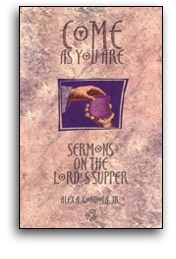
Come As You Are
Sermons On The Lord's Supper
There's an old story about a man who found a pig. It seems that as this man was driving into the city in his station wagon, a stray hog suddenly ran out in front of him. The man stopped the car, jumped out, caught the pig, and put it in the back. Not knowing what to do with the animal, he flagged down the first policeman he saw, explained the situation and asked, "What should I do with this hog?"
"Take him to the zoo," was the officer's response.
The next day the policeman was surprised to see the same man driving by in his station wagon, this time with the pig sitting proudly up in front. He stopped the man and exclaimed, "I thought I told you to take that pig to the zoo!"
"We went there yesterday," said the man. "Today we're going to the movies!"
We may laugh at that story, but confusion in communication is a serious problem, isn't it? The policeman and the man in the story didn't quite understand each other, did they? And they spoke the same language. Think about how difficult communication can be between people speaking different languages and coming from different cultures. According to one estimate, there are about 4,000 different dialects and languages spoken around the globe, over 900 in Asia alone. People speaking in different "tongues" frequently have "language barriers" between them. Misunderstandings, suspicions, and even warfare can result.
One of the authors of the Book of Genesis, writing about 3,000 years ago, tried to explain this tendency for human society to break apart, this constant fracturing of our common life, with the story of the Tower of Babel. I don't take this story literally.
I don't believe that some x-thousand years ago a group of people in Babylon tried to build a tower up to the heavens. And when God saw what they were doing, God felt threatened. So God scattered the people and confused their speech and that's how the world got 4,000 different languages.
I recognize this passage as an ancient myth. But while I don't take it literally, I do take it seriously. The underlying point I see in the Tower of Babel story is that sin drives people apart. The Babylonians in the story, building their tower, were infected with the sin of pride. Scripture tells us their goal was to "make a name for [themselves]" (v. 4). They wanted to "build themselves up" and lift themselves up and show the whole world through their tower that they were somehow "better." They wanted to be able to "look down" on everyone else.
But the sin of pride, once it had crept into their project, destroyed it. I can imagine the ancient builders bickering with one another. One architect says, "I say we put the parapet over here." Another architect responds, "No, I say it belongs over there!" "Yeah? Well, what do you know? I've worked here longer" "So what! I've got more talent in my little finger than you've got in your whole body!" Then the bookkeeper pipes in, "You artistic types will be the end of this project. Didn't you read my memo? I've been keeping accounts, and you've overspent on parapets." And a bricklayer, who's working nearby, takes it all in and thinks to himself, "Executives! What we really need is a working man with some common sense in charge here." And so on. No real communication. No one really listening anymore. The Tower of Babel story tells us truth with a capital T. Sin confuses communication and destroys community. Sin drives people apart.
Someone once pointed out that sin is what a scientist might call a "centrifugal force." You probably know what a centrifuge is. It's one of those instruments that can be used in a laboratory to separate a compound liquid into its various components. As I understand it, the technician puts the liquid into the centrifuge and turns it on. As it spins really fast, the liquid breaks down into heavier and lighter parts which separate out in the test tubes. Like a centrifuge, our sins are constantly spinning us away from the center of life and spinning us apart from each other.
And that's precisely what Satan wants. "Satan" means "adversary," you know. Satan is God's adversary. God created everything to work together, to be in harmony, to be a common unity, a community with God at the center. That was God's vision for what God made, represented by the Garden of Eden, a place where man, woman, and nature lived together in perfect cooperation and peace.
But Satan, God's adversary, wants to destroy all unity, to send everything back to its original confusion and chaos. Sin was introduced into the Garden of Eden, the original unity of creation. The shattered world we have today is the result. We can hear the effects of sin all around us. The discordant babble of voices raised in hatred, the crash of rainforests and the rumble of bulldozers scarring the land, gunfire in our inner cities, rich and poor arguing over who owns what, liberals attacking conservatives and conservatives attacking liberals, husbands and wives arguing and children crying alone in the darkness because no one understands; those sounds rise up from our planet like an unholy symphony, a cry of pain from all of creation. And Satan is pleased. For the adversary's goal is to spin all of us further and further apart until we find ourselves each lost and alone in the outer darkness. Sin seeks to destroy community and connections. And it's very strong.
Fortunately, the breaking-apart force of sin is at every moment being opposed by another force that is trying to bring all things back together. It's a centripetal force, a force that heads to the center. The kind of force that was at work when, as a child, you put some water in a bucket and attached a rope to the handle and swung the bucket on the rope around really fast. And the water didn't spill out because centripetal force was pulling it to the center. God's love is that force that is trying to hold all things together and to bring all things back to God.
That force, God's love, broke out into the world in some new way on the Day of Pentecost. On that day, in spite of differences in language, in spite of differences in culture, thousands of people from dozens of countries were drawn to put Jesus Christ at the center of their lives. On the Day of Pentecost was let loose in some new way a force, the Holy Spirit, which is God's power to bring all humankind and all creation back to a new unity under the headship of Jesus Christ. On that day, through the Holy Spirit, a new creation, the Christian Church, was born.
Satan revels in the ugly babble of chaos and confusion. But God celebrates love and cooperation. And every time, like this morning, that the Holy Spirit brings believers from a variety of different backgrounds together to worship, this scattered and shattered creation heads a little bit back toward its Center. And Satan, the adversary, suffers a defeat. Every time we offer a word of Christian greeting and love, every time we raise our voices for justice on behalf of the poor, every time we profess our common faith, every time our voices are united in a hymn of praise, every time young people publicly profess their faith, every time our hearts are joined in prayer, every time Communion is shared, a sweet harmony rises from the earth, and Satan trembles in terror. For the community that God intended is coming about. And Satan's long, ugly rule will be over.
What we are doing here this Pentecost Sunday and every time we worship together, has profound, eternal significance. We are helping to heal the wounds and divisions that sin has inflicted upon creation. We are moving from the confusion of the Tower of Babel to the communion of Christian love. We are joining God in reuniting creation under the Lordship of Jesus Christ. That process will continue until God has the New Creation, a New Heaven and New Earth, filled with harmony and peace, with Jesus Christ at its center. Pentecost is part of the journey to that New Creation. The divisions are being reversed. The wounds are being healed. We are on the winning side!
"Take him to the zoo," was the officer's response.
The next day the policeman was surprised to see the same man driving by in his station wagon, this time with the pig sitting proudly up in front. He stopped the man and exclaimed, "I thought I told you to take that pig to the zoo!"
"We went there yesterday," said the man. "Today we're going to the movies!"
We may laugh at that story, but confusion in communication is a serious problem, isn't it? The policeman and the man in the story didn't quite understand each other, did they? And they spoke the same language. Think about how difficult communication can be between people speaking different languages and coming from different cultures. According to one estimate, there are about 4,000 different dialects and languages spoken around the globe, over 900 in Asia alone. People speaking in different "tongues" frequently have "language barriers" between them. Misunderstandings, suspicions, and even warfare can result.
One of the authors of the Book of Genesis, writing about 3,000 years ago, tried to explain this tendency for human society to break apart, this constant fracturing of our common life, with the story of the Tower of Babel. I don't take this story literally.
I don't believe that some x-thousand years ago a group of people in Babylon tried to build a tower up to the heavens. And when God saw what they were doing, God felt threatened. So God scattered the people and confused their speech and that's how the world got 4,000 different languages.
I recognize this passage as an ancient myth. But while I don't take it literally, I do take it seriously. The underlying point I see in the Tower of Babel story is that sin drives people apart. The Babylonians in the story, building their tower, were infected with the sin of pride. Scripture tells us their goal was to "make a name for [themselves]" (v. 4). They wanted to "build themselves up" and lift themselves up and show the whole world through their tower that they were somehow "better." They wanted to be able to "look down" on everyone else.
But the sin of pride, once it had crept into their project, destroyed it. I can imagine the ancient builders bickering with one another. One architect says, "I say we put the parapet over here." Another architect responds, "No, I say it belongs over there!" "Yeah? Well, what do you know? I've worked here longer" "So what! I've got more talent in my little finger than you've got in your whole body!" Then the bookkeeper pipes in, "You artistic types will be the end of this project. Didn't you read my memo? I've been keeping accounts, and you've overspent on parapets." And a bricklayer, who's working nearby, takes it all in and thinks to himself, "Executives! What we really need is a working man with some common sense in charge here." And so on. No real communication. No one really listening anymore. The Tower of Babel story tells us truth with a capital T. Sin confuses communication and destroys community. Sin drives people apart.
Someone once pointed out that sin is what a scientist might call a "centrifugal force." You probably know what a centrifuge is. It's one of those instruments that can be used in a laboratory to separate a compound liquid into its various components. As I understand it, the technician puts the liquid into the centrifuge and turns it on. As it spins really fast, the liquid breaks down into heavier and lighter parts which separate out in the test tubes. Like a centrifuge, our sins are constantly spinning us away from the center of life and spinning us apart from each other.
And that's precisely what Satan wants. "Satan" means "adversary," you know. Satan is God's adversary. God created everything to work together, to be in harmony, to be a common unity, a community with God at the center. That was God's vision for what God made, represented by the Garden of Eden, a place where man, woman, and nature lived together in perfect cooperation and peace.
But Satan, God's adversary, wants to destroy all unity, to send everything back to its original confusion and chaos. Sin was introduced into the Garden of Eden, the original unity of creation. The shattered world we have today is the result. We can hear the effects of sin all around us. The discordant babble of voices raised in hatred, the crash of rainforests and the rumble of bulldozers scarring the land, gunfire in our inner cities, rich and poor arguing over who owns what, liberals attacking conservatives and conservatives attacking liberals, husbands and wives arguing and children crying alone in the darkness because no one understands; those sounds rise up from our planet like an unholy symphony, a cry of pain from all of creation. And Satan is pleased. For the adversary's goal is to spin all of us further and further apart until we find ourselves each lost and alone in the outer darkness. Sin seeks to destroy community and connections. And it's very strong.
Fortunately, the breaking-apart force of sin is at every moment being opposed by another force that is trying to bring all things back together. It's a centripetal force, a force that heads to the center. The kind of force that was at work when, as a child, you put some water in a bucket and attached a rope to the handle and swung the bucket on the rope around really fast. And the water didn't spill out because centripetal force was pulling it to the center. God's love is that force that is trying to hold all things together and to bring all things back to God.
That force, God's love, broke out into the world in some new way on the Day of Pentecost. On that day, in spite of differences in language, in spite of differences in culture, thousands of people from dozens of countries were drawn to put Jesus Christ at the center of their lives. On the Day of Pentecost was let loose in some new way a force, the Holy Spirit, which is God's power to bring all humankind and all creation back to a new unity under the headship of Jesus Christ. On that day, through the Holy Spirit, a new creation, the Christian Church, was born.
Satan revels in the ugly babble of chaos and confusion. But God celebrates love and cooperation. And every time, like this morning, that the Holy Spirit brings believers from a variety of different backgrounds together to worship, this scattered and shattered creation heads a little bit back toward its Center. And Satan, the adversary, suffers a defeat. Every time we offer a word of Christian greeting and love, every time we raise our voices for justice on behalf of the poor, every time we profess our common faith, every time our voices are united in a hymn of praise, every time young people publicly profess their faith, every time our hearts are joined in prayer, every time Communion is shared, a sweet harmony rises from the earth, and Satan trembles in terror. For the community that God intended is coming about. And Satan's long, ugly rule will be over.
What we are doing here this Pentecost Sunday and every time we worship together, has profound, eternal significance. We are helping to heal the wounds and divisions that sin has inflicted upon creation. We are moving from the confusion of the Tower of Babel to the communion of Christian love. We are joining God in reuniting creation under the Lordship of Jesus Christ. That process will continue until God has the New Creation, a New Heaven and New Earth, filled with harmony and peace, with Jesus Christ at its center. Pentecost is part of the journey to that New Creation. The divisions are being reversed. The wounds are being healed. We are on the winning side!

