

Proper 10 / Ordinary Time 15 / Pentecost 7
Preaching
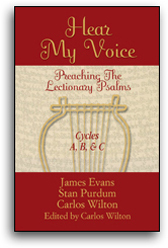
Hear My Voice
Preaching The Lectionary Psalms for Cycles A, B, C
Psalm 119 is a rich treasure trove of wisdom. The longest of the psalms, it follows an acrostic design, with 22 sections each beginning with a different letter of the Hebrew alphabet. This particular section is filled with various wisdom sayings, of which verse 105 is by far the most familiar: "Your word is a lamp to my feet and a light to my path."
That verse offers a familiar, yet important, theme for preaching: an opportunity to teach about the authority of scripture. What can we say about scripture, based on this verse? Several things:
1. Scripture provides illumination for our lives. Seduced by our society's technological might, we have come to believe that we provide our own illumination. This was not true for the ancients, who knew better. Marcus Borg has written:
The symbolism of light and darkness is ancient, archetypal and cross-cultural. It has many rich resonances of meaning. Darkness is associated with blindness, night, sleep, cold, gloom, despair, lostness, chaos, death, danger and yearning for the dawn. It is a striking image of the human condition. Light is seen as the antidote to the above, and is thus an image of salvation. In the light, one is awake, able to see and find one's way; it is associated with relief and rejoicing that the night is over; in the light one is safe and warm. In the light there is life. (From "The Meaning of Jesus: Two Visions," by Marcus J. Borg and N. T. Wright, in the Christian Century, December 16, 1998, pp. 1218-1221.)
2. The illumination that scripture provides is indirect lighting. Many of us have indirect lighting in our homes. It provides beauty as well as functionality. The lamp mentioned in the psalm shines downward, at the portion of the path immediately ahead. It does not project a spotlight's brilliant glare far down the road, as do many modern electric lights. The "lamp to my feet" is more modest than that. Scripture is more like a simple flashlight than a set of automobile high beams. Yet at the slow pace of foot travel, it is really all a traveler needs. In the words of Jewish biblical scholar Abraham Joseph Heschel in Between God and Man:
The surest way of misunderstanding revelation is take it literally, to imagine that God spoke to the prophet on a long-distance telephone. The truth is that things and words stand for different meanings in different situations. Gold means wealth to the merchant, a means of adornment to the jeweler, and kindness to the rhetorician (a golden heart). Light is a form of energy to the physicist, a medium of loveliness to the artist, and an expression of grandeur in the first chapter of the Bible. Ruah, the Hebrew word for spirit, signifies also breath, wind, and direction. And he who thinks only of breath, forfeits the deeper meaning of the word....
3. Scripture is meant to be a constant companion, a light we carry with us. In technically advanced societies such as our own, we have long since ceased to be familiar with true darkness. Our cities and towns are awash with light. Starlight is all but unknown. For biblical people, much of life after sundown was lived in darkness. The light a lamp provided was modest and limited. If you ventured out, most nights, a lamp was no luxury; it was a necessity. It could be the one thing that kept wild animals at bay, and that kept you from getting lost. Referring to the study of scripture, Harry Emerson Fosdick said, "Read until you stumble upon yourself on its pages." The light of scripture does so much more than illumine the road ahead. It illumines our lives as well.
-- C. W.
That verse offers a familiar, yet important, theme for preaching: an opportunity to teach about the authority of scripture. What can we say about scripture, based on this verse? Several things:
1. Scripture provides illumination for our lives. Seduced by our society's technological might, we have come to believe that we provide our own illumination. This was not true for the ancients, who knew better. Marcus Borg has written:
The symbolism of light and darkness is ancient, archetypal and cross-cultural. It has many rich resonances of meaning. Darkness is associated with blindness, night, sleep, cold, gloom, despair, lostness, chaos, death, danger and yearning for the dawn. It is a striking image of the human condition. Light is seen as the antidote to the above, and is thus an image of salvation. In the light, one is awake, able to see and find one's way; it is associated with relief and rejoicing that the night is over; in the light one is safe and warm. In the light there is life. (From "The Meaning of Jesus: Two Visions," by Marcus J. Borg and N. T. Wright, in the Christian Century, December 16, 1998, pp. 1218-1221.)
2. The illumination that scripture provides is indirect lighting. Many of us have indirect lighting in our homes. It provides beauty as well as functionality. The lamp mentioned in the psalm shines downward, at the portion of the path immediately ahead. It does not project a spotlight's brilliant glare far down the road, as do many modern electric lights. The "lamp to my feet" is more modest than that. Scripture is more like a simple flashlight than a set of automobile high beams. Yet at the slow pace of foot travel, it is really all a traveler needs. In the words of Jewish biblical scholar Abraham Joseph Heschel in Between God and Man:
The surest way of misunderstanding revelation is take it literally, to imagine that God spoke to the prophet on a long-distance telephone. The truth is that things and words stand for different meanings in different situations. Gold means wealth to the merchant, a means of adornment to the jeweler, and kindness to the rhetorician (a golden heart). Light is a form of energy to the physicist, a medium of loveliness to the artist, and an expression of grandeur in the first chapter of the Bible. Ruah, the Hebrew word for spirit, signifies also breath, wind, and direction. And he who thinks only of breath, forfeits the deeper meaning of the word....
3. Scripture is meant to be a constant companion, a light we carry with us. In technically advanced societies such as our own, we have long since ceased to be familiar with true darkness. Our cities and towns are awash with light. Starlight is all but unknown. For biblical people, much of life after sundown was lived in darkness. The light a lamp provided was modest and limited. If you ventured out, most nights, a lamp was no luxury; it was a necessity. It could be the one thing that kept wild animals at bay, and that kept you from getting lost. Referring to the study of scripture, Harry Emerson Fosdick said, "Read until you stumble upon yourself on its pages." The light of scripture does so much more than illumine the road ahead. It illumines our lives as well.
-- C. W.

