A Renewed Call
Sermon
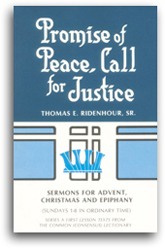
Promise of Peace, Call for Justice
SERMONS FOR ADVENT, CHRISTMAS AND EPIPHANY
Have you ever been blue, worried, discouraged, disappointed about a task or job that you agreed to do, were asked to do, or called to undertake? Have you begun the task or assignment or mission with great hopes, high expectations, and tons of energy only, somewhere along the way, the hopes and expectations seem to be trampled and the energy just flows away into weakness and futility?
Then you know something of the experience of the servant of the Lord in today's Old Testament Lesson. Yahweh God had called this unnamed person from his birth to be the servant of the Lord. Yahweh had named him, had equipped him with the Word of God, for the task and protected him in carrying out the mission. The Lord had called, assigned, sent the servant on a mission to Israel in the Babylonian exile. He was to proclaim the Word of God to a defeated and despairing people. However, in the carrying out of the mission on which he was sent, his zeal and energy appear to have lagged. His own perspective was that all of his labor had been futile and worthless. He appeared to have been spinning his wheels in slippery mud, going nowhere fast. He reports his own discouragement with his work that seems to be without result and value.
The servant of Yahweh is not the only figure in the biblical story who is disappointed and discouraged in his divinely ordained mission. Remember Moses as he led Israelite slaves out of Pharoah's brickyard into freedom in the wilderness, on the way to the land of promise. Moses complains and groans to God a great deal, during the long wilderness trek, about the apparent futility of his ministry. The hard-hearted and stiff-necked people quickly drained Moses' enthusiasm and energy. The apparent silence of God, at times, drove Moses bonkers. He seems almost constantly ready to give up.
Elijah the Tishbite was called to be a prophet of the Lord. He was sent to King Ahab and did his task. Elijah, on behalf of God, engaged in a great contest on Mt. Carmel with the priests of Baal, to demonstrate whether it was Baal or Yahweh God who provided rain for fertility. The contest demonstrated it was Yahweh who gave rain. But then we see Elijah fleeing for his life to Horeb and a cave because Ahab's Queen Jezebel has threatened to kill Elijah the prophet. Elijah tells Yahweh of the worthlessness of his life, his mission, his work. He claims to be the solitary faithful Israelite remaining alive. What's the use, Lord?
Jeremiah of Anathoth was also called by Yahweh God from his birth to be a prophet of the Lord. Jeremiah undertook the mission to speak the Word of the Lord to the people of Judah. But Jeremiah found himself without family without friends, his life threatened, and in his own eyes, his ministry a total disaster. Jeremiah even accuses Yahweh God of being a "deceitful brook, like waters that fail" (Jeremiah 15:18) and of deceiving Jeremiah.
In the midst of twelve years of teaching preaching at a Lutheran Seminary, there have been moments of discouragement and a wondering of what is the value of this task to which I have been called. The struggle to help people make the move from biblical text to vibrant and creative contemporary word in the pulpit often seems futile. The wondering if the grass in the pasture of the parish ministry is not greener. The discouragement of too many demands and not enough energy saps enthusiasm and vitality. And the question rears its head: "Is it of any value?"
Is it of any value? That's the servant's question about his call to mission and his seeking to undertake that mission. However, that is not all the servant reflects upon in our text. He also is confident that Yahweh God will accept his efforts and not forget him. And then, surprise! Surprise! God renews the call and, in that renewing, the mission is neither lightened nor lifted, but is made broader and weightier. Yahweh God calls the servant not just to serve Israel, but to be light to the nations so the salvation of God may reach to the ends of the earth. The servant is promised that, in what appears to him to be futile failure, his mission will be successful because God is faithful to the divine promise made to the one he has chosen.
In meeting Elijah at the cave in Mt. Horeb, Yahweh renews the call to Elijah and promises to strengthen him for the task. Yahweh does not desert nor forget Moses in his leadership task with the freed Israelites. Jeremiah again and again is met by God's word which renews and refreshes him for his prophetic ministry.
In my own discouragement and disappointment, the Lord God meets me in preached and sacramental Word, as the Seminary community gathers for worship to renew and empower my sense of call. Colleagues who are supportive and students who demonstrate care and insight become channels of God's faithful presence to me.
Is it not so for us in our own discouragement, disillusionment, and despair about our call to be God's people in mission, to be a light to the nations? The faithful God comes again and again to us, not letting us off the hook, but renewing our call to be God's people, manifesting the divine light of healing and forgiveness as we return to our baptism, as we hear the Gospel proclaimed, as we receive the broken body and the shed blood of our Lord for the forgiveness of our sins and the strengthening of our faith, and as members of the community of God's people become channels of divine grace that rush into our arid lives with re-creative energy and refreshing vibrancy.
The Lord God has called us to be servants in and to the church and the world. We are called again and again to the mission of our Lord which has been enfleshed in the person of Jesus. Jesus of Nazareth is the Servant of the Lord par excellence. In his death and resurrection, the light of God's salvation has shined, is shining, and will shine throughout the whole earth. The light of God's salvation has been manifested to us and for us in Jesus. He is the reality of God's faithfulness for us. In the serving love of God that has come to us in Jesus we are again and again called to be faithful servants of our God, in spite of our times of discouragement and disappointment. "For the Son of Man also came not to be served but to serve, and to give his life as a ransom for many." (Mark 10:45) The service of the Son of Man was his death on the cross and God has raised Jesus from the dead promising us that God's mission will be fulfilled.
Isaiah 9:1-4
Epiphany 3
Light Shines
Do you know it is very dark at five o'clock in the morning? You can tell I am not used to getting up that early. But it is deep darkness and cold. Stumbling around trying to shave, dress, pack, and get to Washington to catch a plane; while noticing the nice, inviting, warm bed just beckoning me to crawl back in. And the drive from Gettysburg to Washington is dark and depressing, until the sun begins to rise and light penetrates the darkness, only faintly at first, but then stronger and stronger, until the darkness is displaced by light.
Darkness is frightening, depressing, a specter of Godforsakenness. Our present day and age may be, for a good many of us, something like my having to get up at five o'clock this morning. We fumble and stumble in the present darkness while a nice, warm, inviting bed, like the past when things were much simpler and comfortable, beckons us to crawl in and pull the covers over our head.
There were jobs. Money was fairly loose. There were no skyjackings, no threats of terrorists. There was not the dark specter of an economic depression. The feeling was that the leaders had some idea, at least, of what was going on. It just seemed to be better back there in the past. God, couldn't it be like that again, instead of this five o'clock darkness which permeates all the days of our lives now?
And in the midst of the general darkness, in which all of us stumble around, is the deadly despair of a deepening individual darkness. You are unemployed and there seems to be no work anywhere for you. Your spouse is ill and the prognosis is not good. There is deep friction within the family circle, cutting persons into shreds. The darkness seems so thick you could cut it.
My aunt is aged and infirm. Several years ago she sold her home and moved to a retirement village in Chapel Hill, North Carolina. Several weeks ago she fell and broke her hip. She had to be hospitalized and now is back at the retirement village, but in the infirmary there. I am stumbling in darkness for her, but I know very well that she is really crying in her deep darkness.
The times are not very bright with sunshine are they? Yet we are no different from what human beings have ever been. Darkness has always seemed to permeate the human enterprise. Our text for this day is an oracle of Isaiah to Judah and a Davidic King. It is spoken to a people who walked in darkness, a people who dwelt in a land of deep darkness. They were people defeated by a superior military power. The land of promise was decimated by the Assyrian army. Had God deserted, forsaken them? They were crying out in darkness.
Darkness, despair and death are not new things on the human scene. The struggle and pain we undergo are real, but not new. My own pain at five o'clock this morning is known by many of you. But that does not really offer much help in how to deal with it.
The prophet in today's text claims:
The people who walked in darkness have seen a great light;
those who dwelt in a land of deep darkness, on them has light shined.
Thou hast multiplied the nation, thou hast increased its joy;
they rejoice before thee as with joy at the harvest, as men rejoice when they divide the spoil.
For the yoke of his burden, and the staff for his shoulder,
the rod of his oppressor, thou hast broken as on the day of Midian. (Isaiah 9:2-4, RSV)
The prophet claims God is at work in the life of Judah. God is at work to bring light into the midst of darkness. This divine deed is to be accomplished through the human king sitting upon the throne of David. Isaiah speaks a word of promise to the despairing people of Judah.
Today's Gospel proclaims the same word. Jesus begins his public ministry by issuing a call for the people living in darkness and in the shadow of death, extending an invitation for them to repent. But the call, the invitation, is based upon the fact that God has already come to them. Jesus proclaims that God's Kingdom, God's rule has already come to the people who reside in darkness and death. Jesus brings healing, life, and light to those dying and dead in their sin and hurt.
That Word is still alive and productive in the church and our world. The promise of the Gospel is that life is ours. There is light shining in the midst of darkness. The bright morning star shines in fullness and freedom for us in our world.
In the biblical story, light is the sign of the fullness of all the gifts of God. Jesus is the Light of the World in the Fourth Gospel. The Psalmist confesses, "The Lord is my light and my salvation; whom shall I fear?" (Psalm 27:1 RSV) The prophet Second Isaiah sings:
And I will lead the blind in a way they know not
in paths that they have not known I will guide them.
I will turn the darkness before them into light,
the rough places into level ground.
These are the things I will do,
and I will not forsake them. (Isaiah 42:16, RSV)
Surely the darkness permeates our world and our life. I know the gnawing fear in my gut of rising prices, of the pressures of my job, of family responsibilities. I am afraid, at times, of how I am being judged in my job performance by others. I am fearful of terrorists. I am depressed, at times, by the seeming inability of our political leaders to get us out of the mess.
But then I run into words of promise like those found in today's text. A word that proclaims God has not forsaken us, left us alone in the darkness. A word which says God still shines the light of the divine presence in the midst of our darkness. That word of promise becomes a beacon of light penetrating the deep darkness. The word of promise from our God says that Ronald Reagan or the Congress or governors and legislatures, or the Libyans or the Russians or even we ourselves are not in control of life. This word from God promises that life in its deepest, rawest, most essential sense is God's gift to us. And that gift is given flesh and meaning in Jesus of Nazareth, the Light of the World.
This promise does not mean we shall not be afraid, that we shall not stumble and fumble in darkness, or not still do all we can to continue to make life here full and free. But it does seem to me that God's goodness, God's word of promise to be light shining into our world, throws a very illuminating beam into the midst of our darkest moments. This word says we are not alone. This word says we are not defenseless nor deserted. It promises that, in the very deepest darkness of our souls, our lives, our world, God is present with us.
God is present with us. God is wrapped around people who provide support when our job is lost. God is wrapped around communities, like the church, which provide love and help when life falls apart. For my aunt, God comes wrapped in the person of a cousin of mine who visits and expresses love to her. God comes to us wrapped around bread and wine to feed and strengthen us for life here and now.
God is present with us, wrapped in the midst of our present predicaments. Perhaps God is shaking and shattering us in order to wake us up to the realities of our failures, to show us how our systems oppress and make dark life for others, to lead us into new paths of understanding, to direct and call us into new ways of living which can be a means of life which is full and free and just for all people, not just for the privileged few.
God knows it is five o'clock in the morning in our world. God knows it is dark and cold, that we are stumbling and fumbling around, trying to make it. Yet God comes and the beaming light of the divine presence fills our world and our lives with warmth and joy.
We who walk in darkness have seen a great light. We who dwell in a land of deep darkness, on us has light shined. God has increased our joy. God has broken the yokes of oppression that burden us. Our God whom we know so well in Jesus the Christ, is a Wonderful Counselor, a Mighty God, an Everlasting Father, a Prince of Peace. God in Christ shines in the midst of our dark world creating life, renewing the gifts of grace and love, holding us as we stumble and fumble, bringing us into God's Kingdom here and now - God's Kingdom of love and peace and joy.
Micah 6:1-8
Epiphany 4
The Call for Justice
Declan Walsh was a Marine officer in World War II in the Pacific. He began the practice of law, but stayed in the reserves. During the Korean police action he was re-called to active duty with the rank of colonel. He was awarded the Congressional Medal of Honor for saving his command when the Chinese army pushed into the conflict. He returned to his legal life and was named Chief Justice of the United States Supreme Court. His wife, Kate, was killed in an automobile accident in Washington, D.C., and Declan, surprisingly, resigned as Chief Justice and went to a Trappist monastery in South Carolina.
The Roman Pontiff has been killed and the conclave of prelates has gathered at St. Peter's in Rome to elect a new Pope. Declan Walsh, a lay person, is put forward as a potential candidate. A vote is taken in the conclave and Declan Walsh receives the necessary votes to be elected Pope. Ugo Cardinal Galeotti is sent to South Carolina to inform Declan Walsh of his election to be Pope and to discover if Declan will accept the election. After much prayer and soul-searching, Walsh accepts the election and takes the name of Pope Francesco I. This highly imaginative and entertaining scenario is told in Walter F. Murphy's novel, The Vicar of Christ.
Pope Francesco does not play the pontifical game according to the rules the Vatican prelates have established. He is deeply concerned about the realities of justice and insistent that the Roman Catholic Church reshape itself to become a servant for justice in the world. Pope Francesco is unwilling to maintain concordats with oppressive governments. He calls for, and seeks to fund, a massive program of spiritual renewal in the church through retreats, first for the clergy and then for the laity, to assist them in recovering the call to be servants of justice in their parishes. He also seeks to mount a massive campaign for social justice throughout the entire world. He desires to sell some of the wealth of the church to fund this campaign. It is not surprising that Pope Francesco evokes a great deal of hostility to his plan from ecclesiastical leaders and other power brokers. He calls the church to take seriously and become faithful to the call of God for justice and righteousness and steadfast love. In the end, the leadership of Pope Francesco costs him his life by assassination.
Enfleshing God's call for justice in the human community is never popular within religious circles. Our sinnerhood is more concerned with our own safety and security, with our religious ceremonies, and with our own control of life, than it is with giving of ourselves for others.
In Micah 6, God calls Israel to law court to indict them for their sin. The judgment scene takes place in the context of cosmic realities. The Lord asks the people what has been done by God to weary the people. A recital of God's saving deeds in Israel's life is given. Yahweh God has delivered them from Egypt, given them leadership, blessed rather than cursed them through Balaam, and led them across the Jordan into the land of promise. The Lord has delivered, led and saved the people. Why are they now not living faithfully as God's people?
A voice responds to God's controversy against the people. The voice questions what it is God requires and lists cultic and religious acts that may be performed. But the response to the question states clearly what God requires. God does not require things but persons. God has shown us what is required: the people of God doing justice, loving kindness, and walking humbly with their God. Our God requires that we give ourselves as an offering to God, by giving of ourselves for other people in the community.
God seeks and calls for justice to be done by God's people. To do justice is to effect a just social order through not judging one's life according to personal advantage or comfort, nor desiring to dominate other people. To do justice is to deliver the oppressed, to rescue victims of injustice, to restore that which has gone crooked. To do justice is to work for equality for all people in the economic, political, and legal spheres of life so there will not be an inherent
tipping of the scales in favor of the rich and the powerful.
To love kindness is practicing community solidarity. The Hebrew word translated kindness is a covenant word. Kindness or steadfast love is that bonding between God and Israel in the covenant God has made with the people, and is to be the bond which holds together in wholeness the community of God's people. To love kindness is to do the acts of justice that will strengthen and establish community among people from all backgrounds, classes, and colors. To love kindness is to recognize those in need and those excluded from the community, in order to bring and bind them into community of care and protection.
To walk humbly with our God is to live attentively, thoughtfully, watchfully with our God who is concerned with justice and kindness for all people. To walk humbly is not self-effacement, but considered and direct attention to other persons and their needs, and then acting in justice and kindness for those other persons. To walk humbly is to know what God requires and to do it on behalf of all those who are weak, oppressed, and in need.
This text calls each of us radically into question. Far too often we are concerned with what we must do to appease God, rather than with the giving of our own selves for the sake of our neighbors in need. For us, the saving act of God is enfleshed in Jesus the Christ. Through Jesus, God has done justice for us, freeing us from the oppression of sin and making whole our broken relationships with God and with one another. In Jesus, God has bonded us into community with our Lord and with one another. Jesus sought not his own safety and security, but to do the will of God and to give himself for all people.
We know what our God calls for us to do. We know God wants us to offer ourselves as a pleasing sacrifice by attentively discerning our neighbor's needs and acting to meet those needs. In walking humbly with our God, we become more sensitive and adept in our discernment and more resolute in our action, even though we may give up our safety, power, prestige and position. But we can do justice, love kindness, and walk humbly with our God because he/she has already done this for us and promises us there is nothing in the whole cosmos that can separate us from God's love in Christ Jesus. Or to paraphrase Declan Walsh, Pope Francesco I, "God has promised to meet our needs from the divine bounty as we do justice, love kindness, and walk humbly with our God."
Then you know something of the experience of the servant of the Lord in today's Old Testament Lesson. Yahweh God had called this unnamed person from his birth to be the servant of the Lord. Yahweh had named him, had equipped him with the Word of God, for the task and protected him in carrying out the mission. The Lord had called, assigned, sent the servant on a mission to Israel in the Babylonian exile. He was to proclaim the Word of God to a defeated and despairing people. However, in the carrying out of the mission on which he was sent, his zeal and energy appear to have lagged. His own perspective was that all of his labor had been futile and worthless. He appeared to have been spinning his wheels in slippery mud, going nowhere fast. He reports his own discouragement with his work that seems to be without result and value.
The servant of Yahweh is not the only figure in the biblical story who is disappointed and discouraged in his divinely ordained mission. Remember Moses as he led Israelite slaves out of Pharoah's brickyard into freedom in the wilderness, on the way to the land of promise. Moses complains and groans to God a great deal, during the long wilderness trek, about the apparent futility of his ministry. The hard-hearted and stiff-necked people quickly drained Moses' enthusiasm and energy. The apparent silence of God, at times, drove Moses bonkers. He seems almost constantly ready to give up.
Elijah the Tishbite was called to be a prophet of the Lord. He was sent to King Ahab and did his task. Elijah, on behalf of God, engaged in a great contest on Mt. Carmel with the priests of Baal, to demonstrate whether it was Baal or Yahweh God who provided rain for fertility. The contest demonstrated it was Yahweh who gave rain. But then we see Elijah fleeing for his life to Horeb and a cave because Ahab's Queen Jezebel has threatened to kill Elijah the prophet. Elijah tells Yahweh of the worthlessness of his life, his mission, his work. He claims to be the solitary faithful Israelite remaining alive. What's the use, Lord?
Jeremiah of Anathoth was also called by Yahweh God from his birth to be a prophet of the Lord. Jeremiah undertook the mission to speak the Word of the Lord to the people of Judah. But Jeremiah found himself without family without friends, his life threatened, and in his own eyes, his ministry a total disaster. Jeremiah even accuses Yahweh God of being a "deceitful brook, like waters that fail" (Jeremiah 15:18) and of deceiving Jeremiah.
In the midst of twelve years of teaching preaching at a Lutheran Seminary, there have been moments of discouragement and a wondering of what is the value of this task to which I have been called. The struggle to help people make the move from biblical text to vibrant and creative contemporary word in the pulpit often seems futile. The wondering if the grass in the pasture of the parish ministry is not greener. The discouragement of too many demands and not enough energy saps enthusiasm and vitality. And the question rears its head: "Is it of any value?"
Is it of any value? That's the servant's question about his call to mission and his seeking to undertake that mission. However, that is not all the servant reflects upon in our text. He also is confident that Yahweh God will accept his efforts and not forget him. And then, surprise! Surprise! God renews the call and, in that renewing, the mission is neither lightened nor lifted, but is made broader and weightier. Yahweh God calls the servant not just to serve Israel, but to be light to the nations so the salvation of God may reach to the ends of the earth. The servant is promised that, in what appears to him to be futile failure, his mission will be successful because God is faithful to the divine promise made to the one he has chosen.
In meeting Elijah at the cave in Mt. Horeb, Yahweh renews the call to Elijah and promises to strengthen him for the task. Yahweh does not desert nor forget Moses in his leadership task with the freed Israelites. Jeremiah again and again is met by God's word which renews and refreshes him for his prophetic ministry.
In my own discouragement and disappointment, the Lord God meets me in preached and sacramental Word, as the Seminary community gathers for worship to renew and empower my sense of call. Colleagues who are supportive and students who demonstrate care and insight become channels of God's faithful presence to me.
Is it not so for us in our own discouragement, disillusionment, and despair about our call to be God's people in mission, to be a light to the nations? The faithful God comes again and again to us, not letting us off the hook, but renewing our call to be God's people, manifesting the divine light of healing and forgiveness as we return to our baptism, as we hear the Gospel proclaimed, as we receive the broken body and the shed blood of our Lord for the forgiveness of our sins and the strengthening of our faith, and as members of the community of God's people become channels of divine grace that rush into our arid lives with re-creative energy and refreshing vibrancy.
The Lord God has called us to be servants in and to the church and the world. We are called again and again to the mission of our Lord which has been enfleshed in the person of Jesus. Jesus of Nazareth is the Servant of the Lord par excellence. In his death and resurrection, the light of God's salvation has shined, is shining, and will shine throughout the whole earth. The light of God's salvation has been manifested to us and for us in Jesus. He is the reality of God's faithfulness for us. In the serving love of God that has come to us in Jesus we are again and again called to be faithful servants of our God, in spite of our times of discouragement and disappointment. "For the Son of Man also came not to be served but to serve, and to give his life as a ransom for many." (Mark 10:45) The service of the Son of Man was his death on the cross and God has raised Jesus from the dead promising us that God's mission will be fulfilled.
Isaiah 9:1-4
Epiphany 3
Light Shines
Do you know it is very dark at five o'clock in the morning? You can tell I am not used to getting up that early. But it is deep darkness and cold. Stumbling around trying to shave, dress, pack, and get to Washington to catch a plane; while noticing the nice, inviting, warm bed just beckoning me to crawl back in. And the drive from Gettysburg to Washington is dark and depressing, until the sun begins to rise and light penetrates the darkness, only faintly at first, but then stronger and stronger, until the darkness is displaced by light.
Darkness is frightening, depressing, a specter of Godforsakenness. Our present day and age may be, for a good many of us, something like my having to get up at five o'clock this morning. We fumble and stumble in the present darkness while a nice, warm, inviting bed, like the past when things were much simpler and comfortable, beckons us to crawl in and pull the covers over our head.
There were jobs. Money was fairly loose. There were no skyjackings, no threats of terrorists. There was not the dark specter of an economic depression. The feeling was that the leaders had some idea, at least, of what was going on. It just seemed to be better back there in the past. God, couldn't it be like that again, instead of this five o'clock darkness which permeates all the days of our lives now?
And in the midst of the general darkness, in which all of us stumble around, is the deadly despair of a deepening individual darkness. You are unemployed and there seems to be no work anywhere for you. Your spouse is ill and the prognosis is not good. There is deep friction within the family circle, cutting persons into shreds. The darkness seems so thick you could cut it.
My aunt is aged and infirm. Several years ago she sold her home and moved to a retirement village in Chapel Hill, North Carolina. Several weeks ago she fell and broke her hip. She had to be hospitalized and now is back at the retirement village, but in the infirmary there. I am stumbling in darkness for her, but I know very well that she is really crying in her deep darkness.
The times are not very bright with sunshine are they? Yet we are no different from what human beings have ever been. Darkness has always seemed to permeate the human enterprise. Our text for this day is an oracle of Isaiah to Judah and a Davidic King. It is spoken to a people who walked in darkness, a people who dwelt in a land of deep darkness. They were people defeated by a superior military power. The land of promise was decimated by the Assyrian army. Had God deserted, forsaken them? They were crying out in darkness.
Darkness, despair and death are not new things on the human scene. The struggle and pain we undergo are real, but not new. My own pain at five o'clock this morning is known by many of you. But that does not really offer much help in how to deal with it.
The prophet in today's text claims:
The people who walked in darkness have seen a great light;
those who dwelt in a land of deep darkness, on them has light shined.
Thou hast multiplied the nation, thou hast increased its joy;
they rejoice before thee as with joy at the harvest, as men rejoice when they divide the spoil.
For the yoke of his burden, and the staff for his shoulder,
the rod of his oppressor, thou hast broken as on the day of Midian. (Isaiah 9:2-4, RSV)
The prophet claims God is at work in the life of Judah. God is at work to bring light into the midst of darkness. This divine deed is to be accomplished through the human king sitting upon the throne of David. Isaiah speaks a word of promise to the despairing people of Judah.
Today's Gospel proclaims the same word. Jesus begins his public ministry by issuing a call for the people living in darkness and in the shadow of death, extending an invitation for them to repent. But the call, the invitation, is based upon the fact that God has already come to them. Jesus proclaims that God's Kingdom, God's rule has already come to the people who reside in darkness and death. Jesus brings healing, life, and light to those dying and dead in their sin and hurt.
That Word is still alive and productive in the church and our world. The promise of the Gospel is that life is ours. There is light shining in the midst of darkness. The bright morning star shines in fullness and freedom for us in our world.
In the biblical story, light is the sign of the fullness of all the gifts of God. Jesus is the Light of the World in the Fourth Gospel. The Psalmist confesses, "The Lord is my light and my salvation; whom shall I fear?" (Psalm 27:1 RSV) The prophet Second Isaiah sings:
And I will lead the blind in a way they know not
in paths that they have not known I will guide them.
I will turn the darkness before them into light,
the rough places into level ground.
These are the things I will do,
and I will not forsake them. (Isaiah 42:16, RSV)
Surely the darkness permeates our world and our life. I know the gnawing fear in my gut of rising prices, of the pressures of my job, of family responsibilities. I am afraid, at times, of how I am being judged in my job performance by others. I am fearful of terrorists. I am depressed, at times, by the seeming inability of our political leaders to get us out of the mess.
But then I run into words of promise like those found in today's text. A word that proclaims God has not forsaken us, left us alone in the darkness. A word which says God still shines the light of the divine presence in the midst of our darkness. That word of promise becomes a beacon of light penetrating the deep darkness. The word of promise from our God says that Ronald Reagan or the Congress or governors and legislatures, or the Libyans or the Russians or even we ourselves are not in control of life. This word from God promises that life in its deepest, rawest, most essential sense is God's gift to us. And that gift is given flesh and meaning in Jesus of Nazareth, the Light of the World.
This promise does not mean we shall not be afraid, that we shall not stumble and fumble in darkness, or not still do all we can to continue to make life here full and free. But it does seem to me that God's goodness, God's word of promise to be light shining into our world, throws a very illuminating beam into the midst of our darkest moments. This word says we are not alone. This word says we are not defenseless nor deserted. It promises that, in the very deepest darkness of our souls, our lives, our world, God is present with us.
God is present with us. God is wrapped around people who provide support when our job is lost. God is wrapped around communities, like the church, which provide love and help when life falls apart. For my aunt, God comes wrapped in the person of a cousin of mine who visits and expresses love to her. God comes to us wrapped around bread and wine to feed and strengthen us for life here and now.
God is present with us, wrapped in the midst of our present predicaments. Perhaps God is shaking and shattering us in order to wake us up to the realities of our failures, to show us how our systems oppress and make dark life for others, to lead us into new paths of understanding, to direct and call us into new ways of living which can be a means of life which is full and free and just for all people, not just for the privileged few.
God knows it is five o'clock in the morning in our world. God knows it is dark and cold, that we are stumbling and fumbling around, trying to make it. Yet God comes and the beaming light of the divine presence fills our world and our lives with warmth and joy.
We who walk in darkness have seen a great light. We who dwell in a land of deep darkness, on us has light shined. God has increased our joy. God has broken the yokes of oppression that burden us. Our God whom we know so well in Jesus the Christ, is a Wonderful Counselor, a Mighty God, an Everlasting Father, a Prince of Peace. God in Christ shines in the midst of our dark world creating life, renewing the gifts of grace and love, holding us as we stumble and fumble, bringing us into God's Kingdom here and now - God's Kingdom of love and peace and joy.
Micah 6:1-8
Epiphany 4
The Call for Justice
Declan Walsh was a Marine officer in World War II in the Pacific. He began the practice of law, but stayed in the reserves. During the Korean police action he was re-called to active duty with the rank of colonel. He was awarded the Congressional Medal of Honor for saving his command when the Chinese army pushed into the conflict. He returned to his legal life and was named Chief Justice of the United States Supreme Court. His wife, Kate, was killed in an automobile accident in Washington, D.C., and Declan, surprisingly, resigned as Chief Justice and went to a Trappist monastery in South Carolina.
The Roman Pontiff has been killed and the conclave of prelates has gathered at St. Peter's in Rome to elect a new Pope. Declan Walsh, a lay person, is put forward as a potential candidate. A vote is taken in the conclave and Declan Walsh receives the necessary votes to be elected Pope. Ugo Cardinal Galeotti is sent to South Carolina to inform Declan Walsh of his election to be Pope and to discover if Declan will accept the election. After much prayer and soul-searching, Walsh accepts the election and takes the name of Pope Francesco I. This highly imaginative and entertaining scenario is told in Walter F. Murphy's novel, The Vicar of Christ.
Pope Francesco does not play the pontifical game according to the rules the Vatican prelates have established. He is deeply concerned about the realities of justice and insistent that the Roman Catholic Church reshape itself to become a servant for justice in the world. Pope Francesco is unwilling to maintain concordats with oppressive governments. He calls for, and seeks to fund, a massive program of spiritual renewal in the church through retreats, first for the clergy and then for the laity, to assist them in recovering the call to be servants of justice in their parishes. He also seeks to mount a massive campaign for social justice throughout the entire world. He desires to sell some of the wealth of the church to fund this campaign. It is not surprising that Pope Francesco evokes a great deal of hostility to his plan from ecclesiastical leaders and other power brokers. He calls the church to take seriously and become faithful to the call of God for justice and righteousness and steadfast love. In the end, the leadership of Pope Francesco costs him his life by assassination.
Enfleshing God's call for justice in the human community is never popular within religious circles. Our sinnerhood is more concerned with our own safety and security, with our religious ceremonies, and with our own control of life, than it is with giving of ourselves for others.
In Micah 6, God calls Israel to law court to indict them for their sin. The judgment scene takes place in the context of cosmic realities. The Lord asks the people what has been done by God to weary the people. A recital of God's saving deeds in Israel's life is given. Yahweh God has delivered them from Egypt, given them leadership, blessed rather than cursed them through Balaam, and led them across the Jordan into the land of promise. The Lord has delivered, led and saved the people. Why are they now not living faithfully as God's people?
A voice responds to God's controversy against the people. The voice questions what it is God requires and lists cultic and religious acts that may be performed. But the response to the question states clearly what God requires. God does not require things but persons. God has shown us what is required: the people of God doing justice, loving kindness, and walking humbly with their God. Our God requires that we give ourselves as an offering to God, by giving of ourselves for other people in the community.
God seeks and calls for justice to be done by God's people. To do justice is to effect a just social order through not judging one's life according to personal advantage or comfort, nor desiring to dominate other people. To do justice is to deliver the oppressed, to rescue victims of injustice, to restore that which has gone crooked. To do justice is to work for equality for all people in the economic, political, and legal spheres of life so there will not be an inherent
tipping of the scales in favor of the rich and the powerful.
To love kindness is practicing community solidarity. The Hebrew word translated kindness is a covenant word. Kindness or steadfast love is that bonding between God and Israel in the covenant God has made with the people, and is to be the bond which holds together in wholeness the community of God's people. To love kindness is to do the acts of justice that will strengthen and establish community among people from all backgrounds, classes, and colors. To love kindness is to recognize those in need and those excluded from the community, in order to bring and bind them into community of care and protection.
To walk humbly with our God is to live attentively, thoughtfully, watchfully with our God who is concerned with justice and kindness for all people. To walk humbly is not self-effacement, but considered and direct attention to other persons and their needs, and then acting in justice and kindness for those other persons. To walk humbly is to know what God requires and to do it on behalf of all those who are weak, oppressed, and in need.
This text calls each of us radically into question. Far too often we are concerned with what we must do to appease God, rather than with the giving of our own selves for the sake of our neighbors in need. For us, the saving act of God is enfleshed in Jesus the Christ. Through Jesus, God has done justice for us, freeing us from the oppression of sin and making whole our broken relationships with God and with one another. In Jesus, God has bonded us into community with our Lord and with one another. Jesus sought not his own safety and security, but to do the will of God and to give himself for all people.
We know what our God calls for us to do. We know God wants us to offer ourselves as a pleasing sacrifice by attentively discerning our neighbor's needs and acting to meet those needs. In walking humbly with our God, we become more sensitive and adept in our discernment and more resolute in our action, even though we may give up our safety, power, prestige and position. But we can do justice, love kindness, and walk humbly with our God because he/she has already done this for us and promises us there is nothing in the whole cosmos that can separate us from God's love in Christ Jesus. Or to paraphrase Declan Walsh, Pope Francesco I, "God has promised to meet our needs from the divine bounty as we do justice, love kindness, and walk humbly with our God."