
Seasons Of Life/The Beauty Of A Simple Life/A Heart For Eternity
Preaching
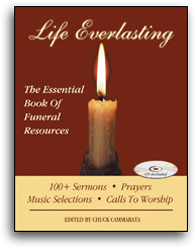
Life Everlasting
The Essential Book of Funeral Resources
Object:
There is a time for everything, and a season for every activity under heaven: a time to be born and a time to die, a time to plant and a time to uproot, a time to kill and a time to heal, a time to tear down and a time to build, a time to weep and a time to laugh, a time to mourn and a time to dance, a time to scatter stones and a time to gather them, a time to embrace and a time to refrain, a time to search and a time to give up, a time to keep and a time to throw away, a time to tear and a time to mend, a time to be silent and a time to speak, a time to love and a time to hate, a time for war and a time for peace.
There is a time for everything! Birth and death. Weeping and laughing. Mourning and dancing. Sometimes we use this passage to state the all too obvious. Everybody dies. This is your time for mourning. But there is so much more to this passage than the beautiful poetry of the first eight verses.
Look at the next few verses.
What does the worker gain from his toil? I have seen the burden God has laid on humanity. Everything is made beautiful in its time. God has also set eternity in human hearts; yet they cannot fathom what God has done from beginning to end. I know that there is nothing better for men and women than to be happy and do good while they live. That everyone may eat and drink, and find satisfaction in their toil -- this is the gift of God. I know that everything God does will endure forever; nothing can be added to it and nothing taken from it. God does it so that all humanity will revere him.
This part of the passage is a reminder that there is much in this life to enjoy. For a person who has died, but who, while on this earth, lived a simple and joyful life, this passage is particularly appropriate. There is a time for everything in life, but as the war and peace and dancing and mourning of the first eight verses is going on around us, the life that finds a way to be happy, do good, eat and drink, be satisfied with whatever work is done -- this is the good life -- a gift from God. So, preach this passage as a celebration of those who lived good, happy, simple lives for these lives are models for us all, and as such, a gift to us.
Also, one can use verse 11 as a focal point in this passage and talk about one who grew in beauty as life lengthened. Maybe there was one whose retirement -- and freedom from stress -- led to a kind of serenity that made them much more beautiful than they once were. This verse also points to the ultimate beautification (glorification) that comes to those who die in Christ and enter the kingdom of God. I used this theme once to speak of a person who had struggled with anger all his life. He had not been a beautiful person in this life, at least not by human measures, but now as he had gone on to reside with his Lord, we could celebrate the final and full beautification of Harry.
Finally, you might take off on the phrase, also in verse 11, "God has set eternity in human hearts." C. S. Lewis said something like this, "If I find in myself a dissatisfaction with this world and a deep desire for another world, it can only mean that I was made for another realm." This echoes the words of Ecclesiastes. God placed eternity in the human heart. There is a deep desire for it; for life that is everlasting and beautiful; for a place where all wrongs are righted; for a place where reunion with all our loved ones takes place. This longing is built into us. Why would God place this desire within us if there was no plan to fulfill the desire? Well, the fact is that God did plan to fulfill the longing, and it happened at the cross. The writer of this passage didn't live to see it -- but resurrection to eternal life was coming, and we have the joy of living on the other side of the fulfillment of this longing. So preach this verse -- especially to a crowd of people who may not know Jesus Christ. Preach of the longing that all of us feel. Make them feel it. And then tell them the wonderful story of the fulfillment of that desire. And maybe even invite them to participate in it. For eternal life doesn't just await us when we leave this world, it can begin now as we live in fellowship with the Lord of Life himself -- Jesus Christ.
There is a time for everything! Birth and death. Weeping and laughing. Mourning and dancing. Sometimes we use this passage to state the all too obvious. Everybody dies. This is your time for mourning. But there is so much more to this passage than the beautiful poetry of the first eight verses.
Look at the next few verses.
What does the worker gain from his toil? I have seen the burden God has laid on humanity. Everything is made beautiful in its time. God has also set eternity in human hearts; yet they cannot fathom what God has done from beginning to end. I know that there is nothing better for men and women than to be happy and do good while they live. That everyone may eat and drink, and find satisfaction in their toil -- this is the gift of God. I know that everything God does will endure forever; nothing can be added to it and nothing taken from it. God does it so that all humanity will revere him.
This part of the passage is a reminder that there is much in this life to enjoy. For a person who has died, but who, while on this earth, lived a simple and joyful life, this passage is particularly appropriate. There is a time for everything in life, but as the war and peace and dancing and mourning of the first eight verses is going on around us, the life that finds a way to be happy, do good, eat and drink, be satisfied with whatever work is done -- this is the good life -- a gift from God. So, preach this passage as a celebration of those who lived good, happy, simple lives for these lives are models for us all, and as such, a gift to us.
Also, one can use verse 11 as a focal point in this passage and talk about one who grew in beauty as life lengthened. Maybe there was one whose retirement -- and freedom from stress -- led to a kind of serenity that made them much more beautiful than they once were. This verse also points to the ultimate beautification (glorification) that comes to those who die in Christ and enter the kingdom of God. I used this theme once to speak of a person who had struggled with anger all his life. He had not been a beautiful person in this life, at least not by human measures, but now as he had gone on to reside with his Lord, we could celebrate the final and full beautification of Harry.
Finally, you might take off on the phrase, also in verse 11, "God has set eternity in human hearts." C. S. Lewis said something like this, "If I find in myself a dissatisfaction with this world and a deep desire for another world, it can only mean that I was made for another realm." This echoes the words of Ecclesiastes. God placed eternity in the human heart. There is a deep desire for it; for life that is everlasting and beautiful; for a place where all wrongs are righted; for a place where reunion with all our loved ones takes place. This longing is built into us. Why would God place this desire within us if there was no plan to fulfill the desire? Well, the fact is that God did plan to fulfill the longing, and it happened at the cross. The writer of this passage didn't live to see it -- but resurrection to eternal life was coming, and we have the joy of living on the other side of the fulfillment of this longing. So preach this verse -- especially to a crowd of people who may not know Jesus Christ. Preach of the longing that all of us feel. Make them feel it. And then tell them the wonderful story of the fulfillment of that desire. And maybe even invite them to participate in it. For eternal life doesn't just await us when we leave this world, it can begin now as we live in fellowship with the Lord of Life himself -- Jesus Christ.

