What Do We Have To Offer?
Preaching
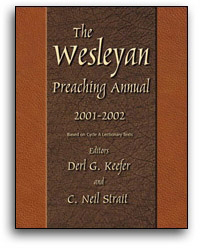
THE WESLEYAN PREACHING ANNUAL 2001--2002
A pastor was asked by a visitor to his church, "What do you have to offer?" The wise pastor answered that the church has Christ to offer him, and the benefits that entails, plus, the empowerment of the Holy Spirit to make him what he needs to be. A pretty good answer.
It put me to thinking. What does the Wesleyan message have to offer? I offer this for your consideration.
One, the young pastor was right, the Wesleyan message offers Christ. Whatever else we Wesleyans have to offer, it must be Christ. He cannot be a secondary part of our emphasis. He must be our first message. When John Wesley went to the mines to preach, often he closed his messages with this phrase, "I offer you Jesus."
Jesus is Savior, Redeemer, our Restorer. Before anyone is ready to take what our Wesleyan heritage would give, they must know Jesus as Savior. They are not ready, or able, to use the other benefits until there is a genuine relationship with Jesus.
Two, the Wesleyan--Holiness church offers the infilling of the Holy Spirit. People are looking for a remedy to sin. While they may not know what the deep need of their life is, every pastor knows that the deepest need is to deal with sin. David Johnson, in his book, Joy Comes In The Morning, states this truth: "We cannot have peace with God unless we are willing to deal with the truth about sin" (Camp Hill, Pa.: Christian Publications, 1998, p. 183).
The holiness message is one of freedom from sin. It is not just about sin management, as Dallas Willard describes some churches, but a freedom over sin. And this is the work of the Holy Spirit. The work of the Holy Spirit, in entire sanctification, is a response to our consecration, our turning our heart over to the Spirit. It is a heart cleansing, an empowerment, by the Spirit, which restores one to the image of Christ.
The General Council of the Christian Missionary Alliance, in giving their report from the Commission on the Doctrine of Sanctification, stated this:
While the gift of divine forgiveness cancels the divine condemnation that over us, biblical sanctification aims at restoring us in the depths of our personhood to the fullness of life revealed in Christ Jesus. It focuses on the restoration in individuals of those qualities of graciousness, kindness, gratitude, patience, compassion, forgiveness, generosity and love that mirror the Divine Image. (Quoted in the Commission on the Doctrine of Sanctification, General Council of the Christian and Missionary Alliance, Indianapolis, In., 1996.)
The Wesleyan message is a message of "freedom from sin" and an inner power, of the Holy Spirit, to live above sin and free from sin.
So the holiness message we have to offer is forgiveness from sin and freedom from sin. It is a message our world needs to hear.
C. Neil Strait
September 1, 2002 Fifteenth Sunday After Pentecost
WORSHIP HELPS
CALL TO WORSHIP
Leader: God, don't turn us away.
People: Or shun us.
Leader: Bring us near to Your Presence.
People: Look upon us - hear us - love us - anoint us
Leader: That Your people will bring honor to Your name,
People: That all will learn Your name: "God, the holy high God of heaven and earth."
OFFERING THOUGHT
We give honor and praise to You with the tithe of our income and with offerings of thanksgiving. Amen.
BENEDICTION
Now unto Him who is capable to keep us from falling from grace and present us to God without spot or wrinkle be glory and majesty, power and strength, for all our days! Glory!
SERMON BRIEFS
The Dance Of Revelation
Exodus 3:1--15
Imagine for a moment you were born in this sanctuary. You have never seen anyone come and go from this room. You are unaware of any life outside this room even though you suspect such life may exist. At night food appears under the door. Somehow the room temperature is controlled. The lights come on in the morning and go off at night. There is no way that you would know that I am the one controlling your situation unless I chose to open a door and reveal myself.
That's what God has done. He opened the door and revealed Himself. That is what's happening here. God is revealing Himself to Moses and as Moses responds positively the door opens further. Let's learn how we should respond when God begins the Dance of Revelation in our lives.
I. When God reveals Himself through His creative activity we should approach Him. (vv. 2--3)
Moses sees a strange sight: a burning bush that is not being consumed. Naturally, Moses approaches the bush to investigate. As God begins the "Dance of Revelation" His first step is to awaken curiosity.
When we look at God's creation there is a natural curiosity that captures our attention. We see the night stars and wonder how all of that happened. Nature is the premier burning bush that awakens our curiosity about God. When that curiosity is stirred we ought to take a look. Many scientists have been stirred by what they saw in nature. They took a look. In the end, they discovered God!
II. When God reveals Himself through calling our name we should answer. (v. 4)
Since Moses responded positively by approaching the bush, God further pushes ajar the door of revelation. The dance continues as God takes the step of calling out Moses' name. This step revealed that God knew about him.
When you begin to approach God He will call out your name. Although it likely will not be an audible calling, you will feel drawn to Him. There will be this feeling that He knows you. Indeed, He does know you, even better than you know yourself. He knows your potential, your hurts, and your dreams.
Look at the response of Moses. He made himself available. When God reveals Himself to you by calling out your name respond by making yourself available. When you indicate your availability God reveals Himself more.
III. When God reveals Himself through revealing His name we should hide our face. (v. 6)
The "Dance of Revelation" continues as God discloses His Name to Moses. Moses responds by hiding his face.
Do you find his reaction strange? In today's culture we have lost all reverence for God. He has become the "Man Upstairs" or the "Big Guy." Moses models for us a reverent awe of God. We need to recapture a sense of the identity of God. He is the God of Abraham, Isaac, and Jacob. He is the God who parted the Red Sea. He is the God who spoke the creative word and our universe sprang into existence.
As God reveals His name to you, respond by hiding your face. Rekindle a sense of awe.
IV. When God reveals Himself through sharing His plans we should accept those plans. (vv. 7--15)
Since Moses showed God proper reverence God continues the "Dance of Revelation" by taking the next step. This is the step of revealing His plans to Moses. Would God have revealed these plans to Moses if Moses had not participated in the dance? Not likely. But as he became an unlikely dance partner with God, God now reveals His will to Moses. The text reveals that Moses struggled to accept those plans. Of course he struggled! God's plans for us are always bigger than any we dared dream for ourselves.
Are you participating in the dance along with Moses? Is God revealing Himself and His plans to you? Wonderful! His plans will turn your life around just as they turned around the life of Moses.
Perhaps you are not accustomed to dancing. That's all right. God is a tremendous dance teacher. As you respond to Him, He will reveal more and more about Himself. And in the end, as the melody continues to play, you will learn about His plans for you. Pay attention. Keep in step!
Randall Hartman
The Shadow Of The Cross
Matthew 16:21--28
If you have small children, then there is one children's story you have probably read more times than you care to admit. It is the story of Peter Pan. Do you remember how that story begins? The opening scene takes place in the nursery of the Darling home. There Wendy, Michael and John are getting ready for bed as Wendy prepares to spend her last night in the nursery.
Suddenly Peter Pan flies into the room. Do you remember what he was doing? He was looking for something. He was looking for his shadow.
Wait a minute! How could he get disconnected from his shadow? How could a person get separated from his shadow, that very essence of himself? But somehow, he did. And he had to fight to capture his shadow and sew it back onto his heels.
The Church of Jesus Christ could be in the very same fix as Peter Pan. It's possible for us to be disconnected from our own shadow. If we're not careful, we can be separated from the symbol that should be the very essence of what we believe, of who we are. We could become disconnected from the cross.
In many cases, the cross is no longer the imposing, central symbol of our faith. It has been relegated to the back wall of the church, or reduced to ornamental jewelry. Why, even God--blaspheming rock stars proudly wear it around their necks or have it tattooed into their skin! In our self--centered society, the cross no longer greatly influences our daily walk, or even our worship. The ideas of self--sacrifice, self--denial, submission and service are increasingly absent from the vocabulary of evangelicalism. Have we become disconnected from the central idea that the cross represents?
We'll look today at one of the pivotal events in Jesus' ministry. A time when he taught his first disciples, and every one of us, that our lives must be characterized by self--denial, submission and service. He calls us to carry the Cross - to let its shadow cover every area of our life.
It's been said that great events cast their shadows before them. It's true. The Persian Gulf War was preceded by months of military build--up. Prior to the eruption of Mount Saint Helens in 1980, there were months of scientific forecasts. Even a dog growls before it bites! Every important event casts a prior shadow.
The cross of Jesus Christ was exactly like that. Like a magnet the hill called Mount Calvary reached back into time to draw Jesus to itself.
When did Jesus begin to feel the weight of the Cross? Early in life, I believe. The cross was in the manger, as they say. It's seen in the lyrics of the gospel song, "He was born in the shadow of a tree." Certainly he felt the tug of the Cross in his twelfth year when he plainly told his parents, "Didn't you know that I must be in my father's house?"
Perhaps the precise moment when Jesus began to feel the shadow of his own death was that day, just before the transfiguration. Matthew records for us these words, "From that time on Jesus began to explain to his disciples that he must go to Jerusalem and suffer many things at the hands of the elders, chief priests and teachers of the law, and that he must be killed and on the third day be raised to life" (v. 21).
It marked a turning point in the ministry of Christ. From that point on the shadow of the Cross falls across his every step. Jesus knew that he must die. He had chosen for himself a life of surrender. He had chosen the way of the Cross. And he insisted that his disciples follow in his path. "If anyone would come after me, let him deny himself, and take up his cross, and follow me." He called his followers to live under the shadow of the Cross.
The important question is this: Are you living in the shadow of the Cross? Has it dawned upon you that anyone who calls himself a Christian must be prepared to make the ultimate sacrifice, the surrender of his or her life to Christ?
You may be more like Peter the apostle once was: Afraid to talk about death. Anxious to change the subject. Slow to comprehend the need for self--denial.
The shadow of the Cross must fall over several areas of your life.
I. The shadow of the Cross must fall over your possessions.
When people are about to die, they loosen their grip on material things. We're told that when someone is about to take their own life they begin to give away their important possessions. Elderly people, sensing that their years are drawing to a close, will often begin to give their heirloom possessions to their children. When you know that you soon will die, possessions have no value. So it is with believers. When you die spiritually, you die to the things of the world. The shadow of the Cross will fall across your possessions.
We Christians must admit that we are not poor people. When I was a kid, all Christians seemed poor. Now we have Christian professionals who call themselves "financial experts"! Now, we tend to gauge ourselves by what we own - a car, home, income, or vacations.
We follow a different kind of master. Jesus, during his life on earth, was essentially homeless. He had only one possession, his clothing, and he was born in a borrowed manger and buried in a borrowed grave. He taught us to deny ourselves, to take up the Cross of sacrifice, and to follow him. In other words, Christians are to be dead to the world. The things of the world should not mean to us what they do to others.
Have you denied yourself? Is the shadow of the Cross on things? How much time do you spend thinking about the next purchase? With the trinkets and toys of the world? Do you gauge yourself against others by your possessions? Is there anything about which you've said: "I would never give this up? When you look at your stuff, do you see the shadow of the Cross over them?"
Jesus says anyone desiring to be a disciple,"If you want to come with me, you must realize the terrible cost. You must deny yourself. You must be willing to separate yourself from the things of this world so completely that they are dead to you. What good does it do for a man to gain the whole world yet forfeit his soul."
Let the shadow of the Cross fall over the things that you own.
II. The shadow of the Cross must fall over your plans.
Vision is the ability to see things before they happen. You have vision. A vision for yourself. A vision for your life. You have plans and dreams and goals. Does the shadow of the Cross fall upon your plans? Do your dreams for yourself include the Cross?
Jesus' disciples understood the need to abandon their plans to follow him. He said, "Come," and they came. Amazing! James and John left two most important things in life: their work and their family. They loosed themselves of everything to tie themselves completely to Jesus.
But they didn't seem to understand all that that meant. One of them even rebuked Jesus for speaking of his death. We follow Jesus in the same way, easily. It is pathetically easy to make converts. Most people are glad to accept forgiveness for sin. And it's not too hard to get people to come to church. But it's harder to communicate the Cross. Self--denial has always been an unpopular concept.
But we are called to "follow," that is, imitate the Christ who denied absolutely everything to redeem us. Does the shadow of the Cross fall on your vision of self? When you look at the future, do you see yourself as more selfish, or more selfless? When you look ahead, do you see more stuff, or less stuff? When you look at your name on that office door, do you see the shadow of the Cross upon your title? When you look five, ten or fifteen years down the road, do you see someone who is more humble, more self--sacrificing, and more emptied of ambition? Or do you see more things, more money, greater status for yourself?
Jesus was telling His disciples, "I don't think you get this. If you want to follow me, then you must go where I go. You must do what I do. You must start to act like me, think like me, talk like me. You have to follow me. And what I am doing is giving myself away."
Is the image of the Cross anywhere in your future? Is there a hill called Mount Calvary somewhere behind you? And does the Cross cast its long shadow over the rest of your life?
III. The shadow of the Cross must fall over your person.
It's been said that beauty is only skin deep. I don't know if that's true or not. But I know that the impression of the Cross must be more than skin deep on us. It must go clear to the bone. It must become a part of our total self, our soul, our person.
The call to carry the Cross is a soul matter. Jesus asked, "What can a man give in exchange for his soul?" (v. 26). The call to deny self and take up the Cross is a call to a life of total commitment. It must become not only what you do, but who you are.
Is the shadow of the Cross upon your heart, your soul? Have you become a person who is like Jesus? Are you filled with love, joy, peace, patience, kindness, goodness, faithfulness, gentleness and self--control? Do you take on the Cross and then put it off again like a convenient coat?
You can't come with Jesus and keep yourself. You can't be his disciple yet reserve a corner of your life that is beyond his control. You have to disappear in his shadow. You have to die to be born again. Is the shadow of the Cross upon your self, your person?
Stan Toler
It put me to thinking. What does the Wesleyan message have to offer? I offer this for your consideration.
One, the young pastor was right, the Wesleyan message offers Christ. Whatever else we Wesleyans have to offer, it must be Christ. He cannot be a secondary part of our emphasis. He must be our first message. When John Wesley went to the mines to preach, often he closed his messages with this phrase, "I offer you Jesus."
Jesus is Savior, Redeemer, our Restorer. Before anyone is ready to take what our Wesleyan heritage would give, they must know Jesus as Savior. They are not ready, or able, to use the other benefits until there is a genuine relationship with Jesus.
Two, the Wesleyan--Holiness church offers the infilling of the Holy Spirit. People are looking for a remedy to sin. While they may not know what the deep need of their life is, every pastor knows that the deepest need is to deal with sin. David Johnson, in his book, Joy Comes In The Morning, states this truth: "We cannot have peace with God unless we are willing to deal with the truth about sin" (Camp Hill, Pa.: Christian Publications, 1998, p. 183).
The holiness message is one of freedom from sin. It is not just about sin management, as Dallas Willard describes some churches, but a freedom over sin. And this is the work of the Holy Spirit. The work of the Holy Spirit, in entire sanctification, is a response to our consecration, our turning our heart over to the Spirit. It is a heart cleansing, an empowerment, by the Spirit, which restores one to the image of Christ.
The General Council of the Christian Missionary Alliance, in giving their report from the Commission on the Doctrine of Sanctification, stated this:
While the gift of divine forgiveness cancels the divine condemnation that over us, biblical sanctification aims at restoring us in the depths of our personhood to the fullness of life revealed in Christ Jesus. It focuses on the restoration in individuals of those qualities of graciousness, kindness, gratitude, patience, compassion, forgiveness, generosity and love that mirror the Divine Image. (Quoted in the Commission on the Doctrine of Sanctification, General Council of the Christian and Missionary Alliance, Indianapolis, In., 1996.)
The Wesleyan message is a message of "freedom from sin" and an inner power, of the Holy Spirit, to live above sin and free from sin.
So the holiness message we have to offer is forgiveness from sin and freedom from sin. It is a message our world needs to hear.
C. Neil Strait
September 1, 2002 Fifteenth Sunday After Pentecost
WORSHIP HELPS
CALL TO WORSHIP
Leader: God, don't turn us away.
People: Or shun us.
Leader: Bring us near to Your Presence.
People: Look upon us - hear us - love us - anoint us
Leader: That Your people will bring honor to Your name,
People: That all will learn Your name: "God, the holy high God of heaven and earth."
OFFERING THOUGHT
We give honor and praise to You with the tithe of our income and with offerings of thanksgiving. Amen.
BENEDICTION
Now unto Him who is capable to keep us from falling from grace and present us to God without spot or wrinkle be glory and majesty, power and strength, for all our days! Glory!
SERMON BRIEFS
The Dance Of Revelation
Exodus 3:1--15
Imagine for a moment you were born in this sanctuary. You have never seen anyone come and go from this room. You are unaware of any life outside this room even though you suspect such life may exist. At night food appears under the door. Somehow the room temperature is controlled. The lights come on in the morning and go off at night. There is no way that you would know that I am the one controlling your situation unless I chose to open a door and reveal myself.
That's what God has done. He opened the door and revealed Himself. That is what's happening here. God is revealing Himself to Moses and as Moses responds positively the door opens further. Let's learn how we should respond when God begins the Dance of Revelation in our lives.
I. When God reveals Himself through His creative activity we should approach Him. (vv. 2--3)
Moses sees a strange sight: a burning bush that is not being consumed. Naturally, Moses approaches the bush to investigate. As God begins the "Dance of Revelation" His first step is to awaken curiosity.
When we look at God's creation there is a natural curiosity that captures our attention. We see the night stars and wonder how all of that happened. Nature is the premier burning bush that awakens our curiosity about God. When that curiosity is stirred we ought to take a look. Many scientists have been stirred by what they saw in nature. They took a look. In the end, they discovered God!
II. When God reveals Himself through calling our name we should answer. (v. 4)
Since Moses responded positively by approaching the bush, God further pushes ajar the door of revelation. The dance continues as God takes the step of calling out Moses' name. This step revealed that God knew about him.
When you begin to approach God He will call out your name. Although it likely will not be an audible calling, you will feel drawn to Him. There will be this feeling that He knows you. Indeed, He does know you, even better than you know yourself. He knows your potential, your hurts, and your dreams.
Look at the response of Moses. He made himself available. When God reveals Himself to you by calling out your name respond by making yourself available. When you indicate your availability God reveals Himself more.
III. When God reveals Himself through revealing His name we should hide our face. (v. 6)
The "Dance of Revelation" continues as God discloses His Name to Moses. Moses responds by hiding his face.
Do you find his reaction strange? In today's culture we have lost all reverence for God. He has become the "Man Upstairs" or the "Big Guy." Moses models for us a reverent awe of God. We need to recapture a sense of the identity of God. He is the God of Abraham, Isaac, and Jacob. He is the God who parted the Red Sea. He is the God who spoke the creative word and our universe sprang into existence.
As God reveals His name to you, respond by hiding your face. Rekindle a sense of awe.
IV. When God reveals Himself through sharing His plans we should accept those plans. (vv. 7--15)
Since Moses showed God proper reverence God continues the "Dance of Revelation" by taking the next step. This is the step of revealing His plans to Moses. Would God have revealed these plans to Moses if Moses had not participated in the dance? Not likely. But as he became an unlikely dance partner with God, God now reveals His will to Moses. The text reveals that Moses struggled to accept those plans. Of course he struggled! God's plans for us are always bigger than any we dared dream for ourselves.
Are you participating in the dance along with Moses? Is God revealing Himself and His plans to you? Wonderful! His plans will turn your life around just as they turned around the life of Moses.
Perhaps you are not accustomed to dancing. That's all right. God is a tremendous dance teacher. As you respond to Him, He will reveal more and more about Himself. And in the end, as the melody continues to play, you will learn about His plans for you. Pay attention. Keep in step!
Randall Hartman
The Shadow Of The Cross
Matthew 16:21--28
If you have small children, then there is one children's story you have probably read more times than you care to admit. It is the story of Peter Pan. Do you remember how that story begins? The opening scene takes place in the nursery of the Darling home. There Wendy, Michael and John are getting ready for bed as Wendy prepares to spend her last night in the nursery.
Suddenly Peter Pan flies into the room. Do you remember what he was doing? He was looking for something. He was looking for his shadow.
Wait a minute! How could he get disconnected from his shadow? How could a person get separated from his shadow, that very essence of himself? But somehow, he did. And he had to fight to capture his shadow and sew it back onto his heels.
The Church of Jesus Christ could be in the very same fix as Peter Pan. It's possible for us to be disconnected from our own shadow. If we're not careful, we can be separated from the symbol that should be the very essence of what we believe, of who we are. We could become disconnected from the cross.
In many cases, the cross is no longer the imposing, central symbol of our faith. It has been relegated to the back wall of the church, or reduced to ornamental jewelry. Why, even God--blaspheming rock stars proudly wear it around their necks or have it tattooed into their skin! In our self--centered society, the cross no longer greatly influences our daily walk, or even our worship. The ideas of self--sacrifice, self--denial, submission and service are increasingly absent from the vocabulary of evangelicalism. Have we become disconnected from the central idea that the cross represents?
We'll look today at one of the pivotal events in Jesus' ministry. A time when he taught his first disciples, and every one of us, that our lives must be characterized by self--denial, submission and service. He calls us to carry the Cross - to let its shadow cover every area of our life.
It's been said that great events cast their shadows before them. It's true. The Persian Gulf War was preceded by months of military build--up. Prior to the eruption of Mount Saint Helens in 1980, there were months of scientific forecasts. Even a dog growls before it bites! Every important event casts a prior shadow.
The cross of Jesus Christ was exactly like that. Like a magnet the hill called Mount Calvary reached back into time to draw Jesus to itself.
When did Jesus begin to feel the weight of the Cross? Early in life, I believe. The cross was in the manger, as they say. It's seen in the lyrics of the gospel song, "He was born in the shadow of a tree." Certainly he felt the tug of the Cross in his twelfth year when he plainly told his parents, "Didn't you know that I must be in my father's house?"
Perhaps the precise moment when Jesus began to feel the shadow of his own death was that day, just before the transfiguration. Matthew records for us these words, "From that time on Jesus began to explain to his disciples that he must go to Jerusalem and suffer many things at the hands of the elders, chief priests and teachers of the law, and that he must be killed and on the third day be raised to life" (v. 21).
It marked a turning point in the ministry of Christ. From that point on the shadow of the Cross falls across his every step. Jesus knew that he must die. He had chosen for himself a life of surrender. He had chosen the way of the Cross. And he insisted that his disciples follow in his path. "If anyone would come after me, let him deny himself, and take up his cross, and follow me." He called his followers to live under the shadow of the Cross.
The important question is this: Are you living in the shadow of the Cross? Has it dawned upon you that anyone who calls himself a Christian must be prepared to make the ultimate sacrifice, the surrender of his or her life to Christ?
You may be more like Peter the apostle once was: Afraid to talk about death. Anxious to change the subject. Slow to comprehend the need for self--denial.
The shadow of the Cross must fall over several areas of your life.
I. The shadow of the Cross must fall over your possessions.
When people are about to die, they loosen their grip on material things. We're told that when someone is about to take their own life they begin to give away their important possessions. Elderly people, sensing that their years are drawing to a close, will often begin to give their heirloom possessions to their children. When you know that you soon will die, possessions have no value. So it is with believers. When you die spiritually, you die to the things of the world. The shadow of the Cross will fall across your possessions.
We Christians must admit that we are not poor people. When I was a kid, all Christians seemed poor. Now we have Christian professionals who call themselves "financial experts"! Now, we tend to gauge ourselves by what we own - a car, home, income, or vacations.
We follow a different kind of master. Jesus, during his life on earth, was essentially homeless. He had only one possession, his clothing, and he was born in a borrowed manger and buried in a borrowed grave. He taught us to deny ourselves, to take up the Cross of sacrifice, and to follow him. In other words, Christians are to be dead to the world. The things of the world should not mean to us what they do to others.
Have you denied yourself? Is the shadow of the Cross on things? How much time do you spend thinking about the next purchase? With the trinkets and toys of the world? Do you gauge yourself against others by your possessions? Is there anything about which you've said: "I would never give this up? When you look at your stuff, do you see the shadow of the Cross over them?"
Jesus says anyone desiring to be a disciple,"If you want to come with me, you must realize the terrible cost. You must deny yourself. You must be willing to separate yourself from the things of this world so completely that they are dead to you. What good does it do for a man to gain the whole world yet forfeit his soul."
Let the shadow of the Cross fall over the things that you own.
II. The shadow of the Cross must fall over your plans.
Vision is the ability to see things before they happen. You have vision. A vision for yourself. A vision for your life. You have plans and dreams and goals. Does the shadow of the Cross fall upon your plans? Do your dreams for yourself include the Cross?
Jesus' disciples understood the need to abandon their plans to follow him. He said, "Come," and they came. Amazing! James and John left two most important things in life: their work and their family. They loosed themselves of everything to tie themselves completely to Jesus.
But they didn't seem to understand all that that meant. One of them even rebuked Jesus for speaking of his death. We follow Jesus in the same way, easily. It is pathetically easy to make converts. Most people are glad to accept forgiveness for sin. And it's not too hard to get people to come to church. But it's harder to communicate the Cross. Self--denial has always been an unpopular concept.
But we are called to "follow," that is, imitate the Christ who denied absolutely everything to redeem us. Does the shadow of the Cross fall on your vision of self? When you look at the future, do you see yourself as more selfish, or more selfless? When you look ahead, do you see more stuff, or less stuff? When you look at your name on that office door, do you see the shadow of the Cross upon your title? When you look five, ten or fifteen years down the road, do you see someone who is more humble, more self--sacrificing, and more emptied of ambition? Or do you see more things, more money, greater status for yourself?
Jesus was telling His disciples, "I don't think you get this. If you want to follow me, then you must go where I go. You must do what I do. You must start to act like me, think like me, talk like me. You have to follow me. And what I am doing is giving myself away."
Is the image of the Cross anywhere in your future? Is there a hill called Mount Calvary somewhere behind you? And does the Cross cast its long shadow over the rest of your life?
III. The shadow of the Cross must fall over your person.
It's been said that beauty is only skin deep. I don't know if that's true or not. But I know that the impression of the Cross must be more than skin deep on us. It must go clear to the bone. It must become a part of our total self, our soul, our person.
The call to carry the Cross is a soul matter. Jesus asked, "What can a man give in exchange for his soul?" (v. 26). The call to deny self and take up the Cross is a call to a life of total commitment. It must become not only what you do, but who you are.
Is the shadow of the Cross upon your heart, your soul? Have you become a person who is like Jesus? Are you filled with love, joy, peace, patience, kindness, goodness, faithfulness, gentleness and self--control? Do you take on the Cross and then put it off again like a convenient coat?
You can't come with Jesus and keep yourself. You can't be his disciple yet reserve a corner of your life that is beyond his control. You have to disappear in his shadow. You have to die to be born again. Is the shadow of the Cross upon your self, your person?
Stan Toler